Best Walking Pad Daily Use Home
Key Takeaway
Stop chasing star ratings, chase your actual routine. The best walking pad isn’t the one with the most features, it’s the one that fits how you actually work, move, and live: WFH, workouts, or both. Nail the practical stuff first; walking surface, noise, portability, motor capacity, cushioning, durability, before you even glance at “smart” extras.
Sweet spot: $250–$400 is where quality, quiet, and price actually balance out for daily use.
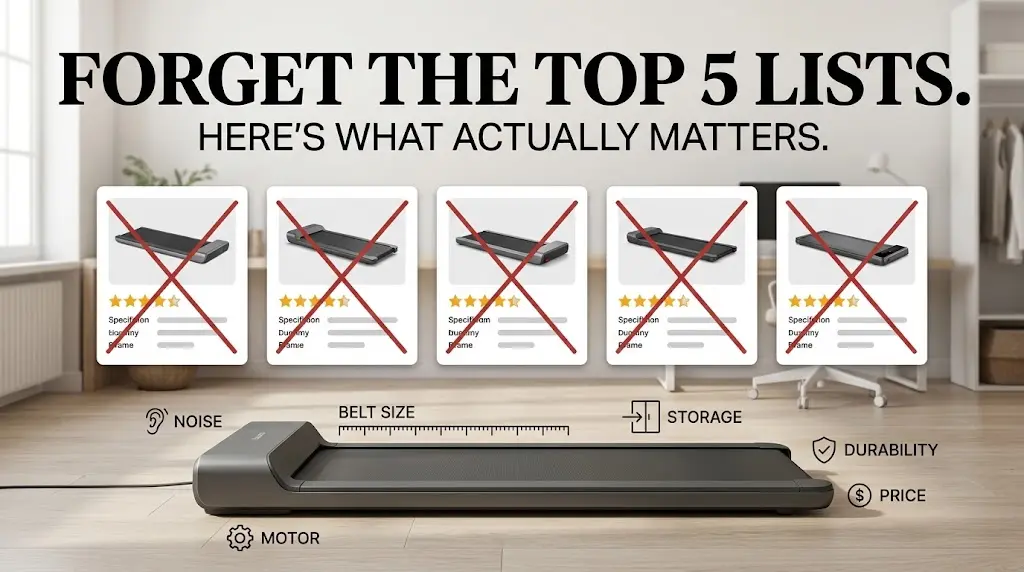
I’ve been thinking about getting a walking pad for almost four months now. Every single time I got close to buying one, I’d open another “Top 5 Walking Pads” article and close it thirty seconds later.
Same five products, same recycled specs, same vague line about how it’s “great for daily use.” Nobody actually told me what I wanted to know: will this thing survive my Zoom calls, my small home office, and my habit of forgetting to put things away?
So I did what I usually do when a topic annoys me enough. I went down a research hole. Reddit threads, owner forums, manufacturer spec sheets, a few sleep-deprived hours comparing motor wattage across brands I’d never heard of. This article is what came out of that. Not a listicle. Not a sponsored ranking. Just the honest version of what I wish someone had handed me back in June.
What I Actually Needed Before I Cared About Specs
The “best” walking pad depends entirely on what your day looks like, not on which model has the highest star rating. Full stop!
For me, most of my walking would happen during work hours: answering emails, sitting through client calls, drafting content while pacing slowly. That’s a completely different use case than someone who wants a 45-minute cardio session after dinner. And it’s a different case again from someone who wants both. Make sense?
I fall into that third group, and honestly, I think most women working from home do too. You don’t want a dedicated office toy and a separate treadmill taking up space. You want one machine that disappears under the desk during the week and still holds up if you decide to walk fast enough to actually sweat on a Sunday.
If your day looks like mine, your priorities should be different from someone buying a machine purely for workouts.
You need something quiet enough not to embarrass you on a call, stable enough that you’re not babysitting your footing while typing, and light enough that putting it away doesn’t feel like a chore.
The Features That Actually Matter for WFH Use
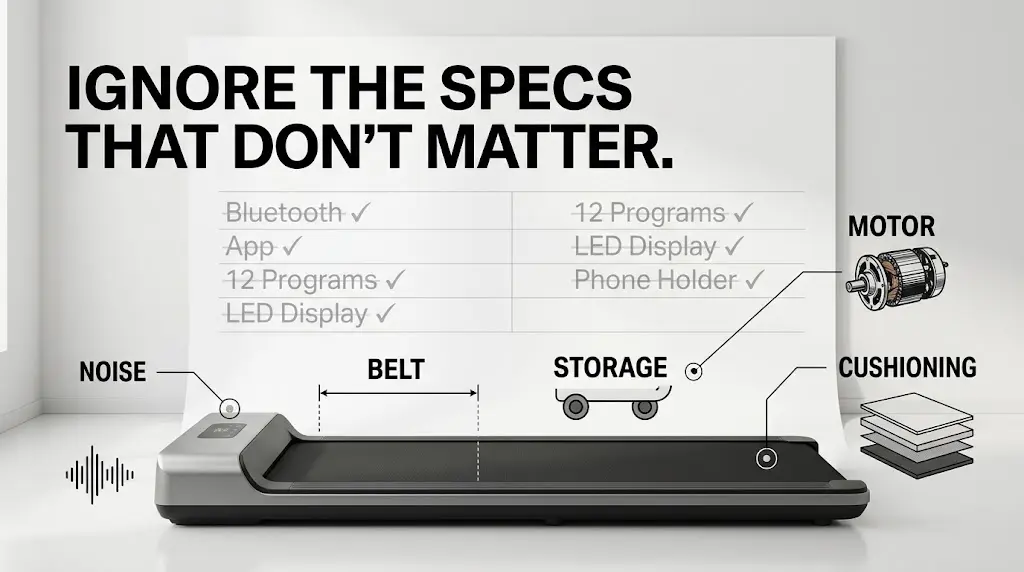
I skimmed past a lot of spec sheets before I figured out which numbers actually mattered day-to-day. A few stood out.
Noise is the first filter, not the last one
This surprised me. I assumed most walking pads would be “quiet” because that’s what every listing claims. But quiet motor noise and quiet walking noise are two different things. A motor can be rated under 50 decibels and still produce a rhythmic thud once someone’s actual footsteps hit the belt.
The CDC’s guidance on physical activity doesn’t cover this directly, but general workplace noise research backs up why it matters more than people think: background noise above conversational levels measurably increases listener fatigue on calls NIOSH on workplace noise.
If you’re on video calls most of your day like I am, this is not a minor detail.
Belt size matters more than footprint
I initially wanted the smallest machine possible, thinking smaller equals easier to hide. Turns out a narrow belt just means you spend your walk worrying about stepping off the edge instead of actually working. A slightly larger footprint that lets you walk naturally is the better trade almost every time.
Storage is a real decision, not an afterthought
If putting the thing away requires effort (folding it, lifting it, calling someone to help move it) you won’t do it every evening. I learned this with a yoga mat storage rack I never used past week two. Machine weight and wheel quality decide whether a walking pad becomes part of your routine or a $300 shelf.
Motor capacity should match your actual workload, not your aspirational one
A machine rated for occasional 20-minute sessions is going to wear out fast if you’re walking on it five hours a day, even at a slow pace. This isn’t about buying the most powerful motor. It’s about being honest with yourself about how much you’ll actually use it.
Cushioning matters more the longer you use it
If you’re walking for two or three hours spread across a workday, the difference between a firm deck and a cushioned one shows up in your knees, not your step count.
This lines up with general research on repetitive low-impact movement and joint load, which consistently points to shock absorption as a meaningful factor over cumulative time, not single sessions Harvard Health on low-impact exercise.
Smart features like apps, Bluetooth, and step tracking are nice, but I’d put them last. A remote that lets you change speed without stopping is genuinely useful. An app that just mirrors what your phone’s step counter already does, not so much.
Design Actually Matters When It Lives in Your House2
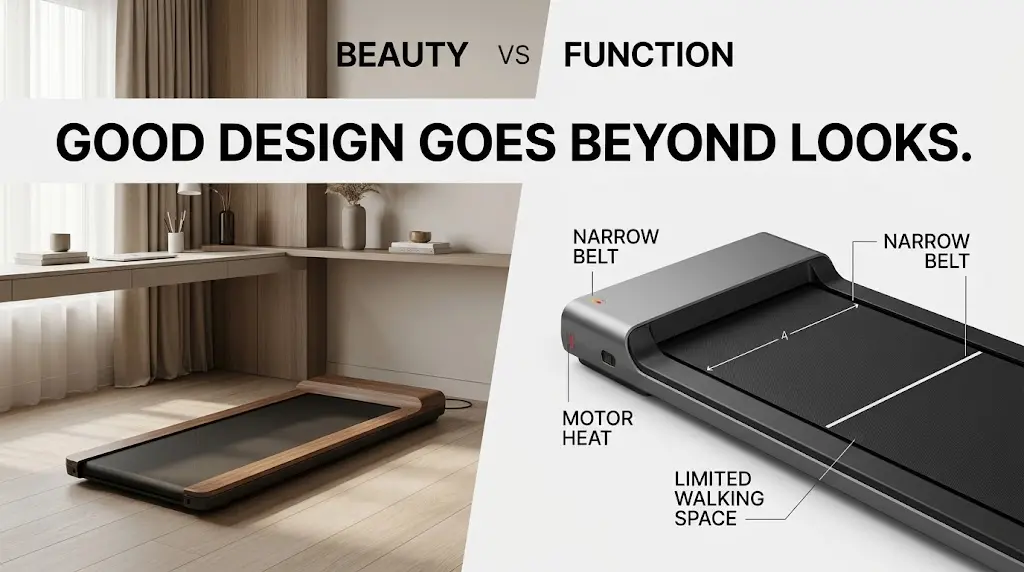
I used to think caring about how a treadmill looks was a little shallow. Then I put one in my home office and realized this thing is going to be visible in every single video call I take for the next two years. It matters.
Walking pads have an advantage traditional treadmills never had. A low profile that doesn’t dominate a room the way a full treadmill with handrails and a console does. That’s a real functional benefit if your office doubles as a guest room or your bedroom, which for a lot of women working from home, it does.
But here’s my one caution after reading through dozens of owner complaints: don’t let aesthetics override function. I saw more than one review where someone bought a beautiful wood-panel model, only to complain a few weeks in about a narrow belt or a motor that ran hot after 40 minutes. A machine that looks perfect next to your desk isn’t a good purchase if you dread using it.
What Owners Actually Say (This Is the Part Manufacturer Pages Skip)
This was the most useful part of my research, and honestly, it’s the part every generic buying guide leaves out entirely.
Digging through owner forums and long-term review threads, a few patterns showed up again and again, across brands:
- Belt maintenance is more involved than new buyers expect. Lubrication, alignment, the occasional squeak that shows up around month three. This isn’t a “set it and forget it” purchase the way marketing copy implies.
- Lighter machines trade off stability. The models people praised most for being easy to store were often the same ones people described as feeling less substantial underfoot. There’s no universal winner here. It’s a real trade-off, not a flaw in any one brand.
- Customer support quality varies wildly, especially with lower-cost, Amazon-first brands. Several long-term reviews mentioned longer wait times for replacement parts than the listing implied.
- Noise complaints were almost never about the motor. They were about belt slap, squeaking after a few months, or vibration transferring into the floor, especially in upstairs offices or apartments, which is relevant if, like me, you live somewhere with shared walls.
None of this shows up on a product page. It only shows up when you read what people say six months after buying, not the day it arrived.
What I’d Actually Spend
Based on everything I read, there’s a pretty clear sweet spot, and it’s not the cheapest option.
- Under $250 gets you into the category, but you’re often trading off belt width, motor durability, or support quality. Fine for occasional, light use. Not ideal if you’re planning to use it most days.
- $250 to $400 is where most of the genuinely well-reviewed, long-term-owned machines sit. This range tends to balance build quality, noise level, and features without paying for gimmicks you won’t touch.
- Above $400 should solve a specific problem. A better folding mechanism, noticeably quieter operation, sturdier construction, not just a bigger screen. If you can’t name the exact thing the extra money is buying you, it’s probably not worth it.
Matching Priorities to the Right Type
Instead of ranking machines, I found it more useful to figure out what kind of buyer I actually am. Maybe this helps you too.
| If you care most about… | Prioritize | Watch out for |
|---|---|---|
| Video calls & WFH days | Quiet operation, stable footing, remote control | Belt noise that doesn’t show up in specs |
| Small apartments | Light weight, wheels, easy folding | Machines that “fold” but still need two people to move |
| Long daily walks | Belt size, cushioning, durability | Small walking surfaces built for short bursts |
| Work + real workouts | Wider belt, stronger motor, higher top speed | Under-desk-only models with low speed caps |
| A home office that looks put-together | Minimal, low-profile design | Choosing looks over actual performance |
| A tight budget | Core performance over add-ons | Paying extra for features you’ll never open |
| Long-term ownership | Build quality, weight capacity, warranty terms | Brands with thin or slow customer support |
The Brands That Kept Coming Up
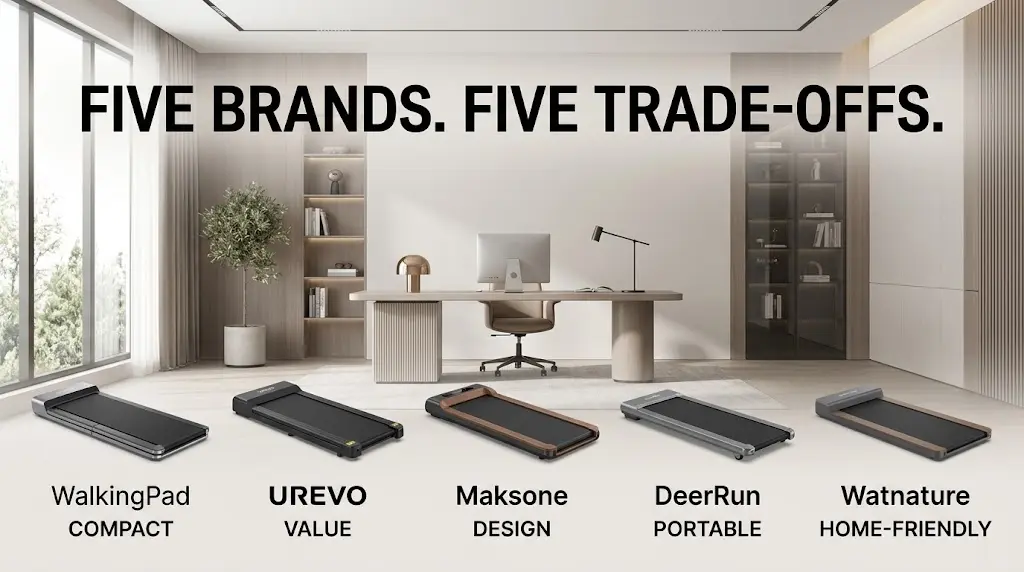
I’m not going to rank these, because “best” depends entirely on which row of that table above matches you.
- WalkingPad shows up constantly in design-focused conversations. Double-folding models, a genuinely compact profile, premium feel. The trade-off owners mention most is weight (heavier than the sleek look suggests) and occasional app frustration.
- UREVO comes up a lot in value-for-money discussions, with a wide range of models. Belt alignment and lubrication maintenance were the most repeated notes from long-term owners.
- Maksone leans into a furniture-like, wood-accented look that blends into a home office well. Real-world feedback flagged some concerns around support response times and performance under heavier daily use.
- DeerRun gets picked for affordability and portability: light, wheeled, easy to move. The trade-off shows up in longevity complaints and occasional overheating after extended sessions.
- Watnature also goes for the home-furniture aesthetic at a lower price point. Owners noted a narrower belt and more basic build, which matters if you’re planning long walking sessions rather than short ones.
How I’m Actually Comparing Two Models Side by Side
Once you’ve narrowed things down, here’s the order I’m using to make the final call, based on everything above:
- Walking surface size
- Real-world noise (not the marketing decibel number)
- Machine weight versus how easily I can move it alone
- Weight capacity against my own body weight, with room to spare
- Speed range for both work-pace walking and actual workouts
- Warranty terms and how responsive support actually is
- Only then: extras like incline, app, Bluetooth
And the one thing I’m doing differently than I used to: reading the negative reviews first, not last. Not to see if people liked it, but to see what specifically went wrong, and how often the same complaint repeats. One person complaining about squeaking after eight months means nothing. Fifteen people saying the same thing means something.
My Quick Checklist Before Buying
- I know if I’m mainly working, exercising, or doing both on it
- I’ve actually measured my floor space
- I know exactly where it’ll live when I’m not using it
- I can move it by myself, no help needed
- The belt gives me room to walk without watching my feet
- The speed range covers both slow work-walks and faster sessions
- The weight capacity has comfortable headroom
- It’s quiet enough for my calls and my walls
- It can handle how often I’ll actually use it, not how often I hope to
- I need the smart features I’m paying for, not just find them cool
- I read the repeated complaints, not just the star rating
- I checked the warranty and support reputation
- The price makes sense for my actual usage, not my ideal usage
FAQs
What’s the best walking pad for working from home?
It’s whichever model matches your noise tolerance, space, and whether you also want it to double as a workout machine. Start with the table above before comparing brands.
Are walking pads quiet enough for video calls?
Most are quieter than a full treadmill, but “quiet” varies a lot by model and by your own footstep habits. Owner reviews are more reliable here than the manufacturer’s decibel rating.
How much should you actually spend?
For daily WFH use, $250 to $400 tends to hit the best balance between durability and price, based on what long-term owners report.
Can you use a walking pad every day?
Yes, but match the motor and belt quality to that workload. A machine built for occasional use will show wear faster under daily walking.
Where I Landed
I didn’t buy the flashiest one. I didn’t buy the cheapest one either. What changed my mind through all of this research is pretty simple: stop shopping based on what looks good in a listing photo, and start shopping based on what people say six months after the return window closes.
Start with your actual routine. Be honest about your non-negotiables. Check the real specs, not the marketing ones. Read what current owners complain about. Then, and only then, spend the money.
Girl, if you have enjoyed reading it, I am open for your feedback. If this is your first time here, don’t forget to read my other articles and tell me your opinions and any other article ideas to explore.
This is my contact page — I am always happy to connect with likeminded peeps! Amna Shahid, Your Bestie!
Stay in Touch, Keep Growing, Keep Loving
← Back to all posts