Why Women Over 25 Have a Stomach Pooch & How to Lose It
Key Takeaways
- A lower belly pooch is not just about fat — it’s often hormonal, structural, or digestive.
- You can’t spot-reduce fat — but you can change your body’s environment to reduce it.
- If it’s not soft fat, it might not be fat at all — and requires a different solution.
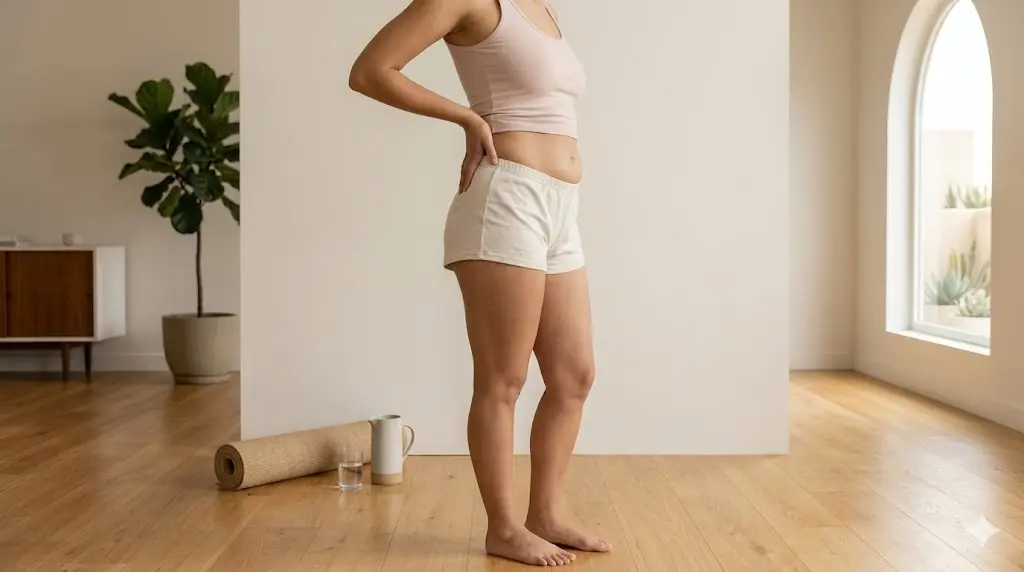 Lower Belly Pooch Explained: It’s Not Just Fat
—
Lower Belly Pooch Explained: It’s Not Just Fat
—
A lot of women over 25 in the U.S. are dealing with the exact same thing. Between desk jobs, stress, poor sleep, hormone changes, takeout meals, and constantly being “on,” our bodies start storing more subcutaneous fat in the lower stomach — especially the soft, pinchable kind that sits below the belly button. I completely relate.
And the frustrating part is that most advice online still tells us to just do more crunches or eat less. This guide is different. I’m breaking down what actually causes lower belly pooch in women — and the realistic, research-backed ways working women like me are finally reducing it without extreme dieting or spending 2 hours in the gym.
How Do I Lose My Belly Pooch Female?
Spot reduction is a myth. Wish someone could have told me this thing in the start. No crunch, no waist trainer, no specific exercise melts fat from one exact area. A woman on reddit posted this:
“I’ve been eating 1,500-1,700 calories a day to lose fat and eating healthier than I ever have. My waistline drops, then goes up, then down again. But the lower part of my belly is what makes my tummy look big no matter what. I eat Subway for lunch with no sauce, chicken breast with egg at home, some rice, and I work at KFC so I eat there once a week. I order out 1-2 times a week too.”
This is a situation a lot of women like us are in — genuinely doing many things right, but a few invisible factors are holding the lower belly in place.
What Foods Should You Avoid to Reduce Lower Belly Pooch?
What you eat creates the hormonal and inflammatory environment your body operates in. These are the biggest dietary drivers of lower belly fat accumulation — backed by research.
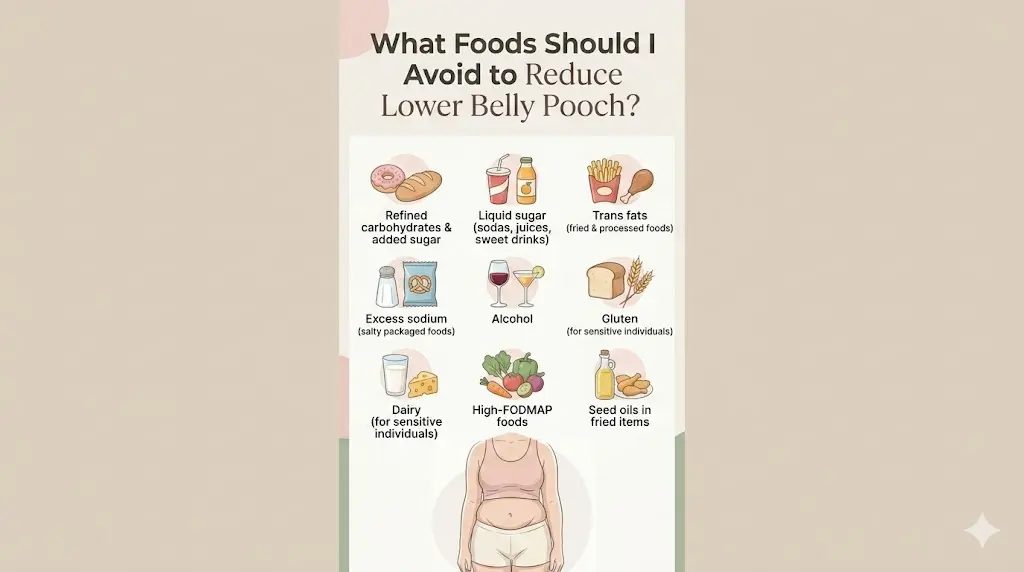 Cut these triggers to calm hormones, reduce bloating, and support lower belly fat loss.
What Are the 5 Superfoods to Burn Lower Belly Fat?
No single food burns fat. But these five have the strongest research evidence for reducing abdominal fat accumulation specifically in us, by improving insulin sensitivity, feeding beneficial gut bacteria, and supporting fat oxidation.
Fatty Fish (Salmon, Sardines, Mackerel)
The omega-3 fatty acids EPA and DHA reduce triglycerides and visceral fat. A 2014 RCT in Nutrition & Metabolismfound fish oil supplementation measurably reduced liver fat and abdominal adiposity in overweight females. Aim for 2-3 servings per week. I eat salmon thrice a week for hair growth and hormonal stability. Did I just touch the whole interesting topic?
Legumes (Lentils, Chickpeas, Black Beans)
High in soluble fiber, which feeds butyrate-producing gut bacteria and stabilizes blood sugar over hours, not minutes. A systematic review in AJCN found that swapping high-glycemic foods for legumes significantly reduced waist circumference across multiple RCTs.
Black beans + chickpeas + cucumber + yoghurt + onion = favourite lunch for summers. Yumm!
Avocados
A 2021 RCT published in The Journal of Nutrition gave women one avocado daily for 12 weeks. The result: significant reductions in visceral abdominal fat and improved insulin sensitivity compared to the control group. The monounsaturated fat and fiber combination appears to be the mechanism. Not a fan of this green!
Plain Greek Yogurt (Probiotic-Rich)
Lactobacillus gasseri strains found in quality probiotic yogurts have been shown in multiple Japanese RCTs to significantly reduce abdominal fat mass over 12 weeks. The protein content also supports muscle retention during a calorie deficit, which keeps your metabolism from tanking.
I usually prefer yoghurt without sweetener, it boosts my metabolism.
Green Tea (EGCG-Rich, Unsweetened)
EGCG (epigallocatechin gallate) enhances fat oxidation, particularly during moderate-intensity exercise. A meta-analysis of 11 RCTs found that green tea catechins combined with exercise produced significantly greater reductions in abdominal fat than exercise alone. 3-4 cups daily is the threshold used in most studies. I usually drink before bed.
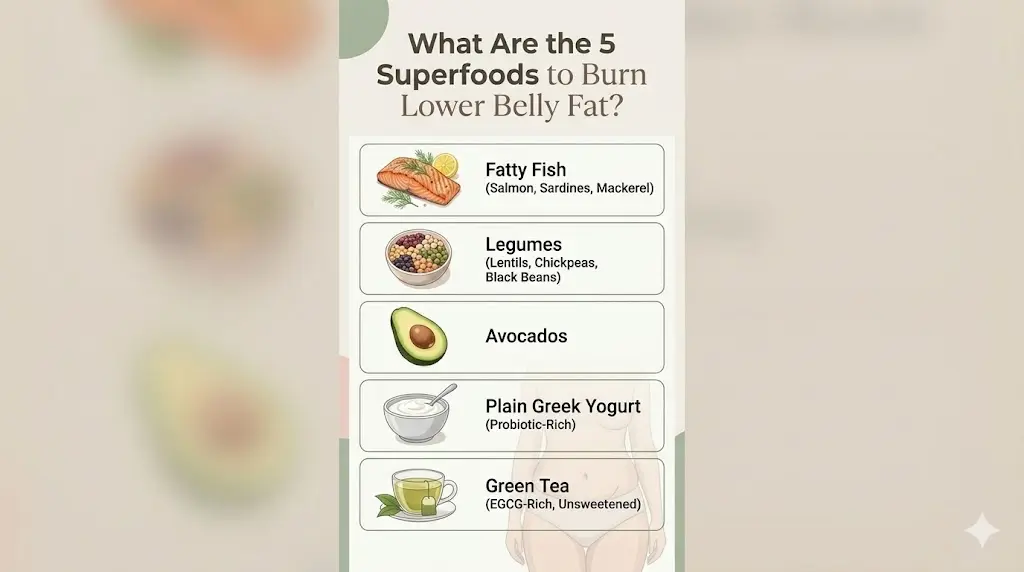 These nutrient-rich foods can support fat metabolism when combined with a healthy lifestyle.
—
These nutrient-rich foods can support fat metabolism when combined with a healthy lifestyle.
—
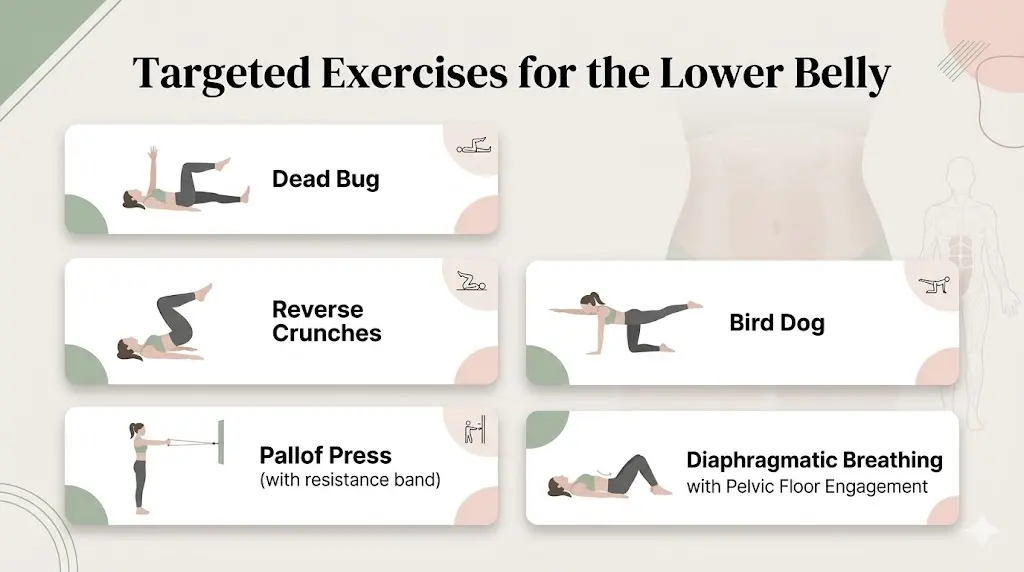
Targeted Exercises for the Lower Belly
You can build the deep core muscles that support your spine, lift your pelvic floor, and literally change the silhouette of your lower abdomen — even at the same body fat percentage. For women with diastasis recti (very common post-C-section), the right exercises also close the midline gap that causes the “pregnant-looking” protrusion.
These are the most evidence-supported moves for us, and none of them are regular crunches:
Dead Bug
My lower abs hate them. The gold standard for TVA (transverse abdominis) activation. It builds your deepest core layer without loading the spine or worsening any ab separation. Physical therapists recommend this for postpartum rehab universally.
Reverse Crunches
Fan of them! EMG studies show 28% greater lower-ab activation compared to standard crunches, with far less neck and hip flexor compensation. Keep your lower back pressed firmly into the floor.
Pallof Press (with resistance band)
Anti-rotation core training that builds the deep stabilizers that sit-ups never reach. Stand sideways to an anchor point, press the band straight out, hold. Your whole core fires to resist rotation.
Bird Dog
Builds core-pelvis coordination, essential for women whose lower belly protrusion is partly postural. Slow and controlled is the entire point here. They work really well for sexy back.
Diaphragmatic Breathing with Pelvic Floor Engagement
Underrated almost everywhere. Breathing into your belly fully, then exhaling with a gentle pelvic floor lift, directly trains the TVA-pelvic floor connection that determines how much your lower abdomen protrudes. I always do this as post workout.
Important if you have had a C-section or suspect diastasis recti: Standard crunches, sit-ups, and many Pilates exercises can worsen the midline gap. Have a pelvic floor physiotherapist assess you before beginning any core program. This is not optional — it is the difference between progress and making things worse. [Lee & Hodges, JOSPT 2016]
“For women whose belly feels firm, protrudes without being soft, and does not change with diet — please see a pelvic floor physio before any exercise program. Exercises will not fix structural separation, organ positioning, or gut-related distension. You need a diagnosis first.”
Cardiovascular Activity
Cardio is one of the most powerful tools for overall fat reduction, with particular impact on visceral and abdominal fat. The research is fairly clear on what works best:
HIIT (High-Intensity Interval Training)
A 2018 meta-analysis of 36 studies in British Journal of Sports Medicine found HIIT reduced waist circumference by 4.3 cm more than moderate-intensity steady-state cardio, in 40% less total exercise time. 2 sessions per week is the sweet spot for most women — more than that raises cortisol and can backfire on lower belly fat specifically. I prefer once a week on bollywood songs.
Zone 2 / Low-Intensity Steady State (LISS)
Do not dismiss walking. Zone 2 (roughly 60-70% max heart rate — you can still hold a conversation) primarily uses fat as fuel. Dr. Inigo San-Millan at University of Colorado has published extensively showing Zone 2 is the primary driver of mitochondrial fat oxidation. 30-45 minutes of brisk walking daily has a profound cumulative effect on lower belly fat over 8-12 weeks. Thinking about this one now.
A practical weekly combination that works for most women: 2 HIIT sessions + 3-4 LISS sessions (brisk walking, cycling, swimming). Keep your HIIT sessions under 25 minutes. Keep your Zone 2 sessions enjoyable enough that you will actually do them.
Lifestyle and Stress Management
Cortisol is, without question, one of the biggest hidden drivers of lower belly fat in women. The stress hormone directly signals abdominal fat cells to hold on and accumulate — and it disproportionately affects women, who tend to show stronger cortisol responses to emotional and social stressors than men.
- Get 7-9 hours of actual sleep — not just time in bed. Sleep is a metabolic intervention, not a luxury.
- Add 10 minutes of slow diaphragmatic breathing or meditation daily. Apps like Insight Timer are free and effective.
- Do not eat while stressed or distracted. Cortisol during eating impairs digestion and shifts nutrient partitioning toward fat storage. This one is hard to follow.
- Limit caffeine after 2pm — caffeine extends the cortisol response and disrupts deep sleep architecture even when it doesn’t obviously prevent you from falling asleep.
- If you have undiagnosed GI symptoms (bloating, irregular digestion, food sensitivities), pursue a GI evaluation. Gut inflammation can cause lower abdominal distension that no lifestyle habit will fix without treating the underlying issue.
Non-Surgical and Medical Options
For women who have genuinely done the foundational work and still struggle — or for those whose lower belly protrusion has a structural or hormonal root cause — these are the options worth knowing about:
Pelvic Floor Physiotherapy
This is the most underutilized and most impactful option for post-pregnancy and post-C-section women. A pelvic floor physio can assess for diastasis recti, organ prolapse, and pelvic floor dysfunction — all of which produce a lower abdominal protrusion that looks like fat but isn’t. Many women who think they have a belly fat problem actually have a 2-3 finger diastasis that makes their abs physically incapable of holding things flat. Treatment works. Most people see improvement in 8-12 weeks.
CoolSculpting (Cryolipolysis)
FDA-cleared for subcutaneous fat reduction. A meta-analysis in Aesthetic Surgery Journal found an average 25% reduction in subcutaneous fat layer thickness after one treatment. Best for specific, stubborn pockets of fat in people who are otherwise at a healthy weight.
EMSCULPT NEO
Combines electromagnetic muscle stimulation with radiofrequency fat reduction. Clinical studies show an average 30% reduction in subcutaneous fat and 25% increase in local muscle mass after 4 sessions. Some women find it helpful post-diastasis repair for rebuilding lower ab musculature.
GLP-1 Agonists (Semaglutide/Wegovy)
The STEP-1 trial in NEJM showed an average 14.9% body weight reduction with semaglutide 2.4mg, with significant visceral and subcutaneous abdominal fat reduction. Requires physician prescription, ongoing monitoring, and is best suited for those with metabolic health concerns rather than cosmetic goals alone.
Functional GI and Hormonal Testing
For women with undiagnosed GI issues, food sensitivities, ovarian cysts, or hormonal irregularities: a comprehensive workup including gut microbiome testing, SIBO breath test, hormonal panel (estrogen, progesterone, cortisol, thyroid), and pelvic ultrasound can identify causes that no exercise program will address.
“One thing worth saying plainly: if your lower belly protrusion is firm, doesn’t change much day to day, and you’re otherwise lean — please see a doctor before spending money on aesthetic treatments. You may be dealing with something medical, not cosmetic.”
Which Drink Burns Belly Fat?
No drink burns belly fat on its own. But several beverages have legitimate research supporting their role in reducing abdominal fat over time — and one category makes everything dramatically worse.
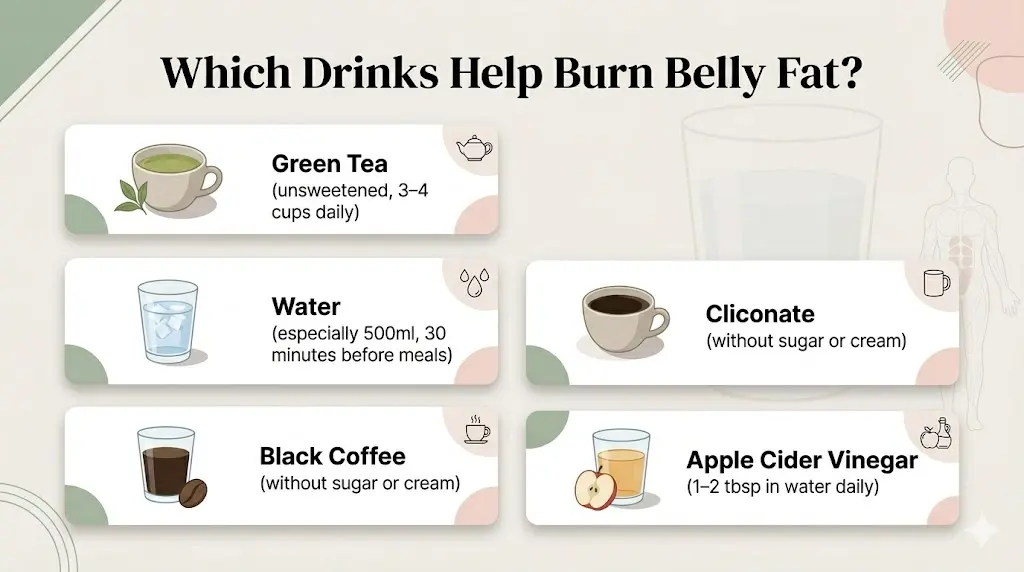 Drinks that burn belly fat fast
Before you can fix the problem, you need to know which type of belly fat you are dealing with — or whether it is fat at all.
Conclusion
Getting rid of a lower stomach pooch is not about quick fixes, extreme dieting, or endless crunches. It’s about understanding what your body is actually dealing with — whether that’s fat distribution, hormones, posture, stress, or gut health.
Once you identify the real cause, your approach becomes more targeted and effective. With the right combination of nutrition, movement, stress management, and in some cases medical support, visible and lasting change is absolutely possible — but it requires patience, consistency, and the right strategy for your specific body.
Frequently Asked Questions
1. What is the best breakfast for losing belly fat?
High-protein, high-fiber breakfasts consistently outperform low-protein options in clinical trials — not just for weight loss, but specifically for abdominal fat reduction. Research-backed options include eggs with vegetables, plain Greek yogurt with berries and chia seeds, or a protein shake with oats. If your breakfast is mainly carbs — even “healthy” carbs — shifting toward protein first will likely produce visible results in 4-6 weeks.
2. What is the 3-3-3 rule for weight loss?
The 3-3-3 rule is a simple daily framework that captures three evidence-supported habits: eat 3 balanced meals per day (avoiding the grazing pattern that keeps insulin elevated all day), stop eating at least 3 hours before bed (aligned with research on circadian eating patterns and improved sleep quality), and drink 3 liters of water throughout the day. It is not an official clinical protocol, but it works because it wraps three independently proven behaviors into one rule that’s easy to follow. Think of it as a floor, not a ceiling.
3. What kills belly fat the fastest?
A moderate calorie deficit (around 500 kcal/day, not a crash diet), HIIT 2x per week, 7-9 hours of sleep, and active cortisol management. Speed matters less than sustainability — the approach that works the fastest is the one you can actually maintain for 12+ weeks, because lower belly fat, especially the hormonal kind, responds to sustained consistency rather than intense short-term effort.
4. What’s the worst carb for belly fat?
Fructose — particularly in liquid form in sodas and fruit juices — is the carbohydrate most strongly linked to visceral and abdominal fat accumulation. Unlike glucose, which your muscles and brain can use directly, fructose is metabolized almost entirely by the liver, which converts excess amounts into triglycerides and VLDL particles that directly fuel visceral fat storage. If you drink soda, juice, or sweetened beverages regularly, eliminating those alone often produces visible waist reduction within a month.
5. What foods are metabolism killers?
The most research-supported foods and eating patterns that suppress metabolic rate, impair fat burning, or make the lower belly worse specifically: ultra-processed foods, alcohol, highly processed seed oils, crash diets under 1200 calories, and eating while stressed or rushed.
I’m Amna Shahid, a content and SEO writer focused on turning complex health and wellness research into simple, practical insights women can actually use. This article is based on a combination of peer-reviewed studies, clinical research, and real experiences shared by women struggling with persistent lower belly pooch. My goal is to bridge the gap between science and everyday life — so you’re not just told what to do, but understand why it works. While this guide is educational and research-backed, it is not a substitute for medical advice, and any persistent or unusual symptoms should always be discussed with a qualified healthcare professional.
← Back to all posts