Pcos Belly Fat Smoothies.
Key Takeaways
- Most store-bought and fruit-heavy smoothies worsen PCOS belly fat by spiking blood sugar. A true PCOS smoothie requires protein (20–30g) + healthy fat + fiber in every single blend.
- Timing matters: drinking your smoothie as breakfast or within 30 minutes post-workout gives the best blood sugar and satiety response for PCOS.

Introduction: Why Your Body Is Playing by Different Rules
Many doctors tell women with PCOS to avoid smoothies altogether — but what they often mean is store-bought, sugar-loaded smoothies filled with fruit juice, syrups, and hidden sugars. That’s very different from a balanced homemade smoothie built for blood sugar control.
You need to read this: with PCOS, you can’t blindly follow wellness trends or Instagram aesthetics. What works for someone else may worsen your cravings, bloating, or belly fat. You have to understand what your body responds to.
Smoothies can either help your hormones or work against them — and the difference usually comes down to ingredients and portions. If you’re also looking beyond smoothies, this list of PCOS belly fat loss drinks women 25–40 swear by is worth a read. Fruits are healthy, but sugar is still sugar, even when it comes from “natural” sources. Blending multiple fruits together without enough protein, fiber, or healthy fats can spike blood sugar fast, especially if you already have insulin resistance.
That doesn’t mean you need to fear smoothies or fruits. It just means you need to be mindful. If you enjoy fruit, pair it properly. If you enjoy smoothies, build them in a way that supports your hormones instead of chasing health trends that were never designed for PCOS in the first place.
Why Most Smoothies Are the Wrong Move for PCOS (And How to Fix Them)
Before we get to recipes, I think it’s worth spending two minutes here, because this is where I see the most well-meaning mistakes.
Blending fruit breaks down the plant cell walls, releasing sugars faster than chewing does. When there’s no protein, fat, or fiber to slow down that absorption, you get a rapid glucose spike — which triggers a massive insulin response — which tells your body to store the excess as fat, specifically around your belly.
A 2017 study published in PLOS Medicine confirmed that whole fruit consumption is associated with lower diabetes risk, while fruit juice consumption is associated with higher risk — and blended high-sugar smoothies behave more like juice than whole fruit when they lack the “buffer” ingredients.
The fix is specific and non-negotiable: Every PCOS smoothie needs three things working together:
- Protein (20–30g) — slows gastric emptying, blunts insulin response, keeps you full
- Healthy fat (1–2 tbsp) — further slows digestion, supports hormone production
- Fiber (from seeds or greens) — binds to sugar, slows absorption, feeds the gut microbiome
Remove any one of these three, and you’re back to a blood sugar problem.
Best PCOS Breakfast Smoothie Recipes
The best PCOS breakfast smoothies do one primary job: prevent an insulin spike in the first two hours of your day, because those two hours set the hormonal tone for everything that follows. Research consistently shows that a high-protein breakfast reduces subsequent food cravings and improves glycemic control — a critical lever for anyone with PCOS. (Healthline: Protein and Blood Sugar)
Here are three recipes I recommend. Each one is built on the protein + fat + fiber framework, uses low-glycemic fruit, and comes together in under five minutes.
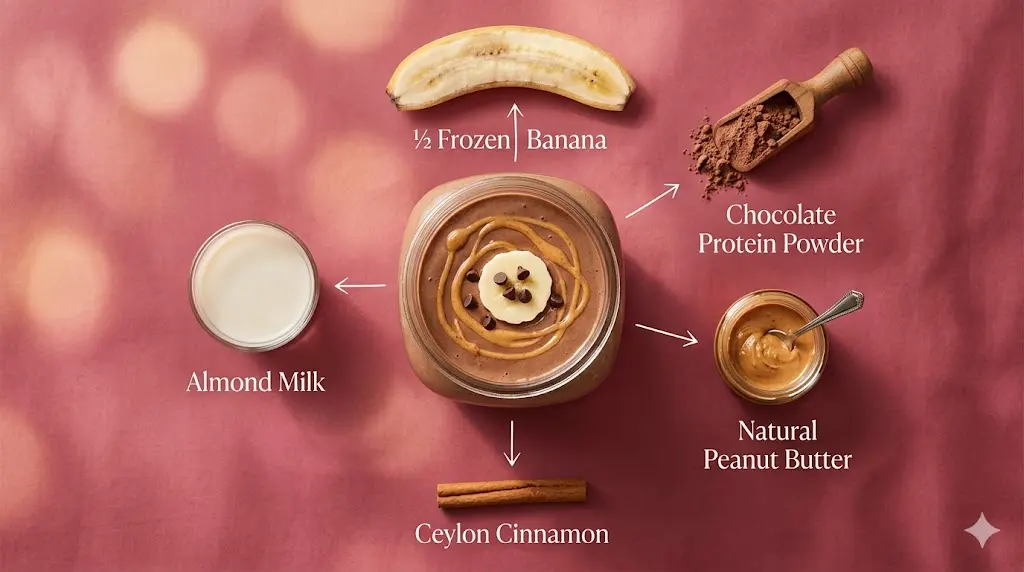
1. Chocolate Peanut Butter Banana Smoothie
This one tastes like dessert, but it functions like medicine for your blood sugar.
| Ingredient | Amount | Why It’s In Here |
|---|---|---|
| Unsweetened almond or coconut milk | 1 cup | Low-carb liquid base, no added sugar |
| Frozen banana (half only) | ½ medium | Provides potassium and creaminess; frozen = lower GI than ripe |
| Chocolate protein powder (low sugar) | 1 scoop (~25g protein) | The non-negotiable anchor of every PCOS smoothie |
| Natural peanut butter (no added sugar) | 1 tbsp | Healthy fat, slows digestion |
| Ground Ceylon cinnamon | ½ tsp | Shown in multiple RCTs to improve insulin sensitivity in PCOS (Healthline: Cinnamon and Blood Sugar) |
Blend all ingredients until smooth. Drink immediately.
Why it works:
- The protein + fat combination suppresses ghrelin (the hunger hormone) for 3–4 hours.
- The half-banana keeps the glycemic load low while providing the creamy texture that makes this actually enjoyable to drink every morning.
- Ceylon cinnamon — not Cassia — is the variety studied for insulin sensitization; a meta-analysis in Nutrition Research found it significantly reduced fasting blood glucose and insulin levels in people with insulin resistance.
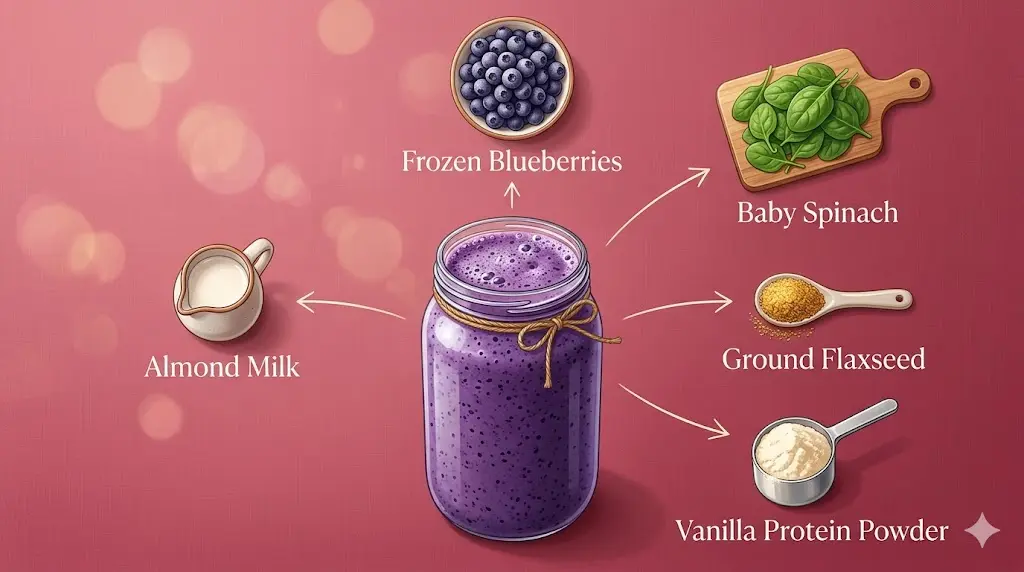
2. Blueberry Spinach Green Smoothie
The PCOS powerhouse. Unglamorous name, extraordinary nutritional profile.
| Ingredient | Amount | Why It’s In Here |
|---|---|---|
| Unsweetened soy or almond milk | 1 cup | Soy milk adds ~7g protein on its own |
| Baby spinach (loosely packed) | 1 cup | Magnesium-rich; magnesium deficiency is common in insulin resistance |
| Frozen blueberries | ½ cup | Among the lowest-GI fruits; rich in anthocyanins shown to reduce insulin resistance |
| Ground flaxseed | 1 tbsp | Lignans support estrogen metabolism; critical for PCOS hormone balance |
| Vanilla protein powder | 1 scoop (~25g) | Core protein anchor |
Blend greens and liquid first (30 seconds), then add remaining ingredients.
Why it works:
- Blueberries are consistently cited as one of the best fruits for insulin resistance. A study in The Journal of Nutrition found that blueberry bioactives (primarily anthocyanins) improved insulin sensitivity in obese, insulin-resistant adults. (Blueberries and Health)
- Ground flaxseed — not whole flaxseed, which passes through undigested — delivers lignans that support healthy estrogen metabolism, which is directly relevant to PCOS hormone imbalance. (Flaxseed Benefits)
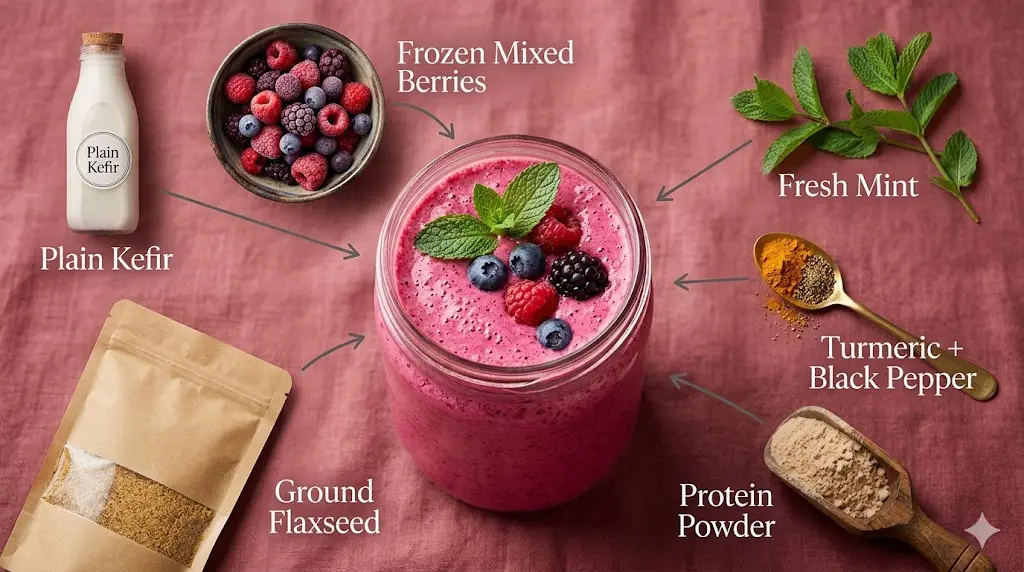
3. Gut-Healing Kefir Berry Blast
This one is for the women whose PCOS comes with chronic bloating, IBS-like symptoms, or skin issues. Emerging research links PCOS with gut dysbiosis (an imbalanced gut microbiome), and probiotics may help modulate this.
| Ingredient | Amount | Why It’s In Here |
|---|---|---|
| Plain full-fat kefir (dairy or coconut) | ½ cup | Live probiotic cultures; full-fat slows digestion |
| Frozen mixed berries | ½ cup | Low-GI antioxidant base |
| Ground flaxseed | 1 tbsp | Fiber + omega-3s |
| Protein powder | 1 scoop | Core protein anchor |
| Ground turmeric | ½ tsp | Curcumin is a proven anti-inflammatory |
| Black pepper | Pinch | Piperine increases curcumin bioavailability by up to 2,000% (Healthline: Turmeric Benefits) |
| Fresh mint | A few leaves | Digestive support, flavor |
Note: If you are dairy-sensitive, coconut kefir works equally well for the probiotic benefit.
High-Protein PCOS Smoothies for Belly Fat Loss
Protein is the single most impactful variable in a PCOS smoothie for belly fat specifically. Here’s why it matters beyond just “staying full”:
High protein intake directly reduces androgens. A 2012 study in Obesity found that a higher protein diet (>30% of calories) reduced free testosterone levels and improved menstrual regularity in women with PCOS over 6 months. Testosterone is the primary androgen driving abdominal fat storage in PCOS. (Healthline: High Protein Diet Benefits)
Protein also suppresses ghrelin more effectively than carbohydrates or fat, meaning it’s the macro most responsible for killing the relentless hunger and carb cravings that insulin resistance creates. (PubMed: Protein and Satiety, PMID 16469977)
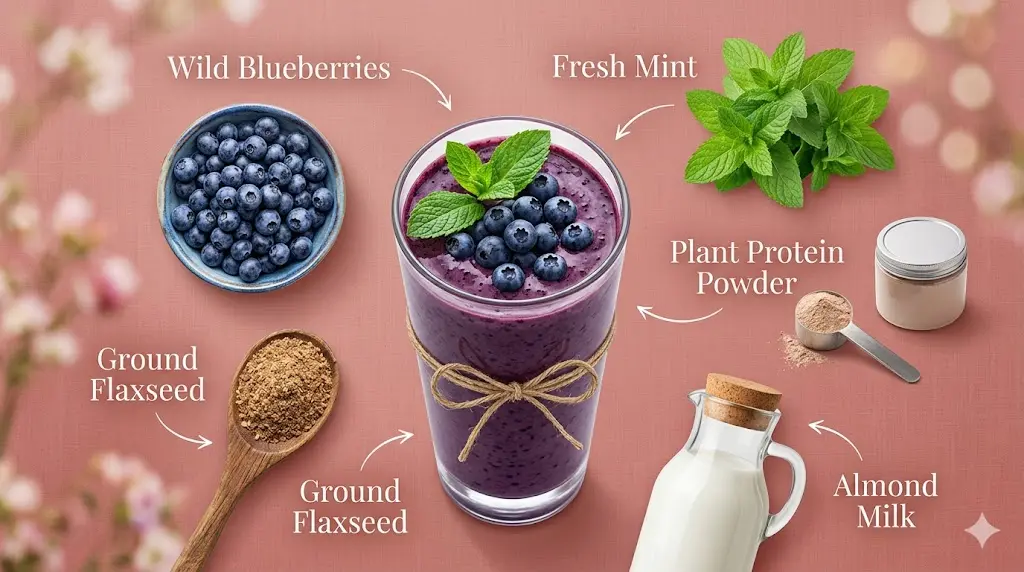
Recipe 1: The Berry-Mint Flat Belly Smoothie
- 1 cup unsweetened almond milk
- 1 scoop plant-based vanilla protein powder
- 1 cup frozen blueberries
- 5 fresh mint leaves
- 1 tbsp ground flaxseed
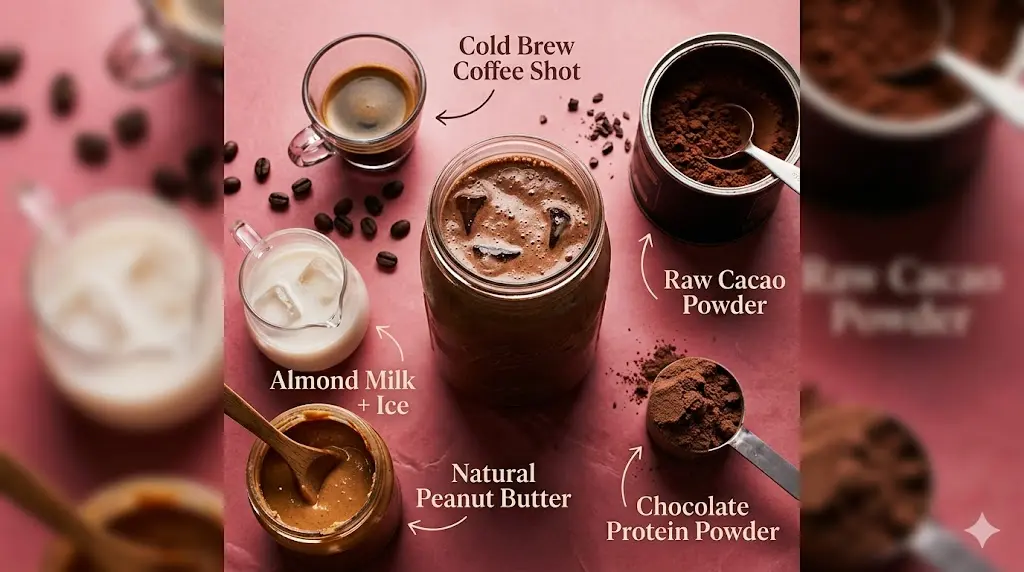
Recipe 2: High-Protein Cacao Coffee Smoothie
- ½ cup unsweetened almond milk + 4 ice cubes
- 1 shot cold-brewed coffee
- 1 scoop plant-based chocolate protein powder
- 1 tbsp raw cacao powder
- ½ tbsp natural peanut butter
Why it targets belly fat:
- Caffeine modestly increases fat oxidation, particularly when consumed before exercise.
- Raw cacao — not Dutch-processed cocoa — is rich in magnesium, and magnesium deficiency is significantly more prevalent in women with PCOS than in those without it.
- A 2015 meta-analysis in Diabetes & Metabolic Syndrome found that magnesium supplementation significantly reduced fasting insulin levels.
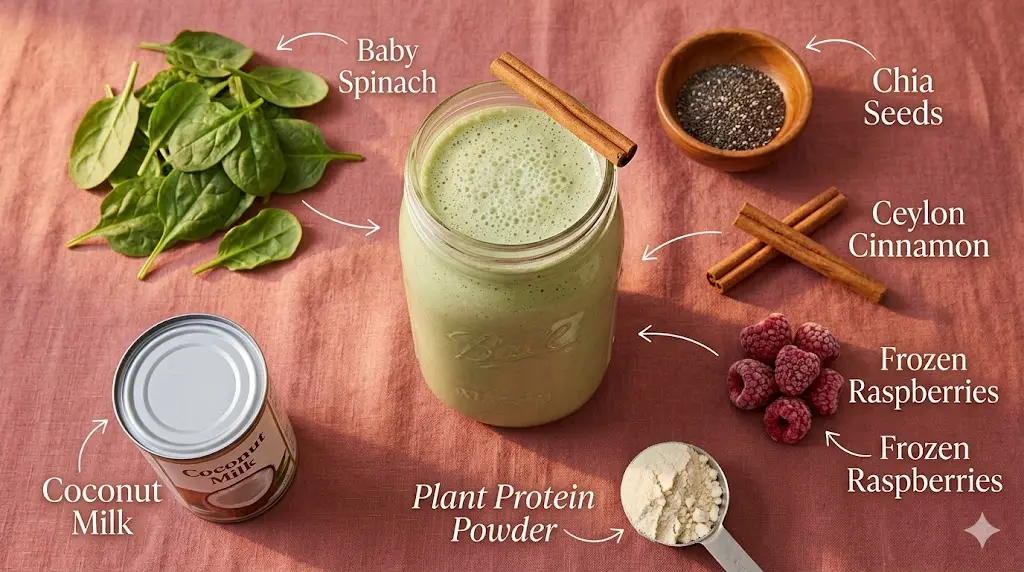
Recipe 3: The Spiced Green Smoothie
- 1 cup unsweetened coconut milk
- 1 scoop plant-based protein powder
- 1 cup baby spinach
- 1 tbsp chia seeds
- ½ cup frozen raspberries
- ½ tsp Ceylon cinnamon
Why it targets belly fat:
- Raspberries are among the highest-fiber fruits available (8g per cup), and their anthocyanin content is comparable to blueberries.
- Chia seeds deliver a notable dose of ALA omega-3s, and their gel-forming soluble fiber (glucomannan-like in effect) slows gastric emptying dramatically, blunting post-meal blood sugar spikes. (Healthline: Chia Seeds for Weight Loss)
Hormone Balancing Smoothie Recipes for PCOS
Hormone balance in PCOS is primarily about two things: lowering excess androgens and improving insulin sensitivity, because these two problems feed each other in a loop. Food isn’t a replacement for medical treatment, but specific ingredients have real, researched mechanisms for supporting hormonal health.
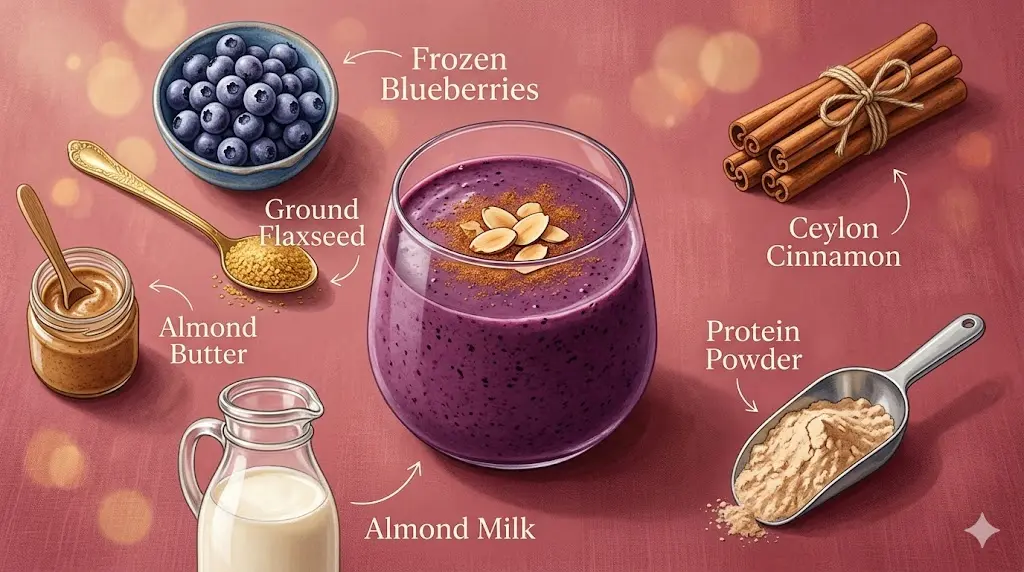
Recipe 1: Blueberry & Flax Hormone Balancer
- 1 cup unsweetened almond or coconut milk
- ½ cup frozen blueberries
- 1 scoop unsweetened protein powder (min. 20g protein)
- 1 tbsp ground flaxseed
- 1 tbsp almond butter
- ½ tsp cinnamon
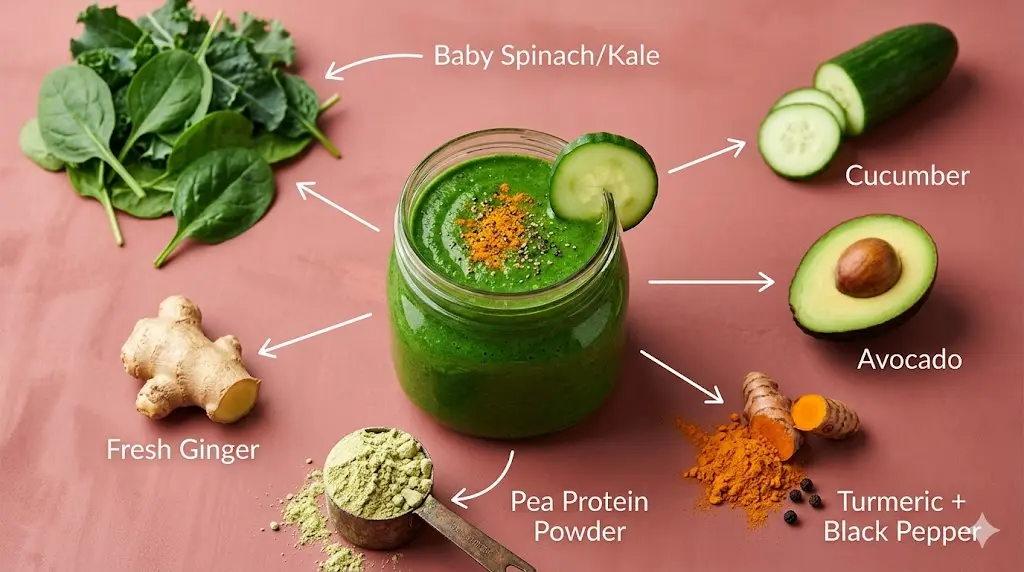
Recipe 2: Anti-Inflammatory Green Machine
- 1 cup unsweetened milk of choice
- 1 handful fresh spinach or kale
- ½ cup cucumber or frozen zucchini
- ¼ avocado
- ½ tsp turmeric + pinch of black pepper
- 1 tsp fresh grated ginger
- 1 scoop collagen or pea protein powder
The hormone angle:
- Curcumin (from turmeric) has been studied specifically in PCOS. A 2018 RCT published in Phytotherapy Research found curcumin supplementation significantly reduced testosterone, DHEA-S, fasting insulin, and insulin resistance scores in women with PCOS compared to placebo.
- The black pepper is not optional — piperine is what makes curcumin bioavailable. (Healthline: Turmeric Curcumin)
- Ginger has separately demonstrated anti-androgen properties in preclinical studies, and a 2015 RCT found it improved regularity of menstrual cycles in women with PCOS. (Healthline: Ginger Health Benefits)
Recipe 3: Maca & Cinnamon Energy Boost
- 1½ cups unsweetened dairy-free milk
- 1–2 tsp maca powder
- 2 tbsp almond butter
- 1 tbsp raw cacao powder
- ½ tsp ground cinnamon
- 1–2 medjool dates (use sparingly; they’re fiber-containing but calorie-dense)
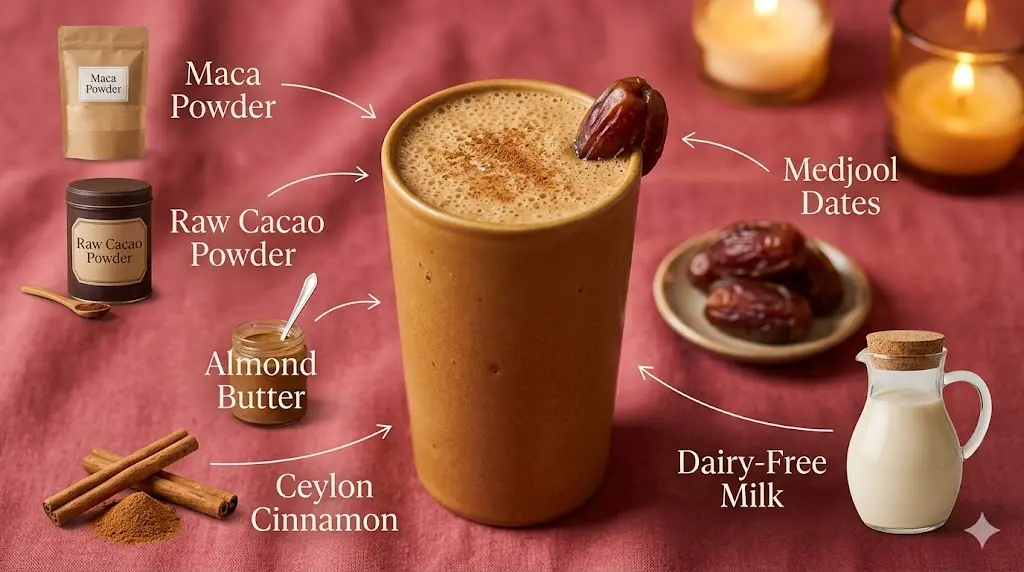
Note: If you are pregnant or on hormonal medications, speak with your doctor before adding maca.
Pro-tip: Many women managing PCOS add inositol powder (specifically myo-inositol or a 40:1 myo:D-chiro blend) directly to their smoothies. A 2019 meta-analysis in International Journal of Endocrinology found inositol significantly improved ovulation, reduced testosterone, and lowered fasting insulin in women with PCOS. (PubMed: Inositol Meta-Analysis, PMID 31073310) It’s flavorless, dissolves completely, and is one of the most evidence-backed supplements for PCOS.
Smoothies for Insulin Resistance and PCOS Cravings
Let me be direct about what insulin resistance actually does to your appetite, because I think this context is what separates “I’ll try to eat better” from “I now understand exactly why I’ve been failing.”
When your cells are resistant to insulin, glucose can’t get in efficiently. Your brain — which runs on glucose — starts sending distress signals: feed me, feed me now, and make it fast-digesting carbs. This is not weakness. This is a neurological response to cellular starvation. The fatigue, brain fog, and intense carb cravings you feel are your brain trying to compensate for an energy delivery problem.
This is exactly why a PCOS smoothie that blunts the insulin spike is so powerful — it addresses the source of the cravings, not just the symptom.
Recipe 1: Chocolate-Berry Cravings Crusher
- 1 cup unsweetened almond milk
- 1 handful spinach
- 1 scoop chocolate protein powder
- 1 tbsp almond butter
- ½ cup mixed frozen berries
- 1 tsp raw cacao powder
- ½ tsp Ceylon cinnamon
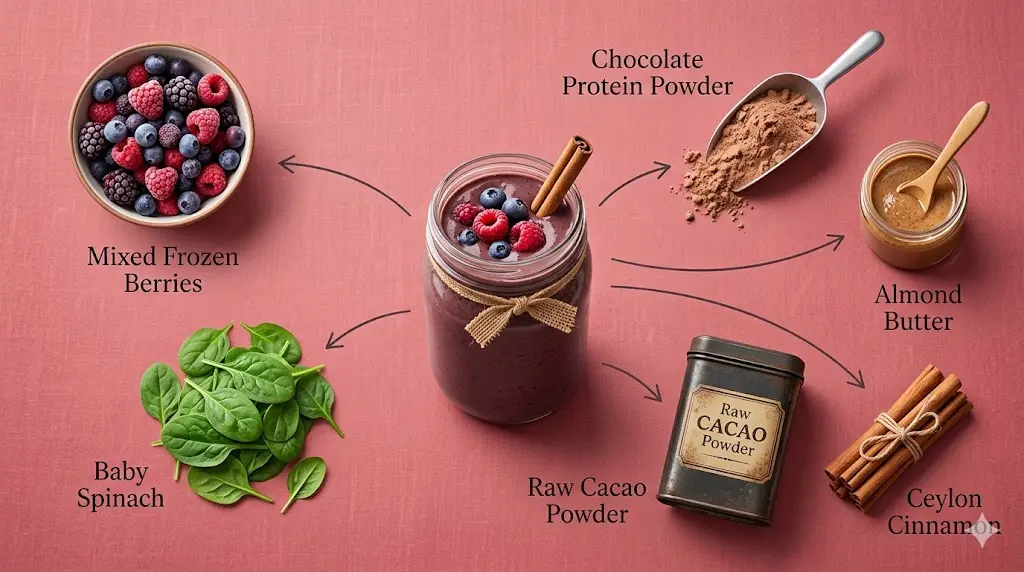
This is the recipe I’d recommend for women who have intense sugar cravings in the morning. The cacao provides a mild dopamine boost (theobromine) without caffeine jitteriness, and the cinnamon acts as a natural insulin sensitizer.
Recipe 2: Creamy Green Hormone Balancer
- 1 cup unsweetened almond milk
- ½ cup baby spinach
- ½ small avocado
- ½ tbsp freshly ground flaxseed
- ½ frozen banana
- ½ tsp cinnamon
- 1 scoop vanilla protein powder
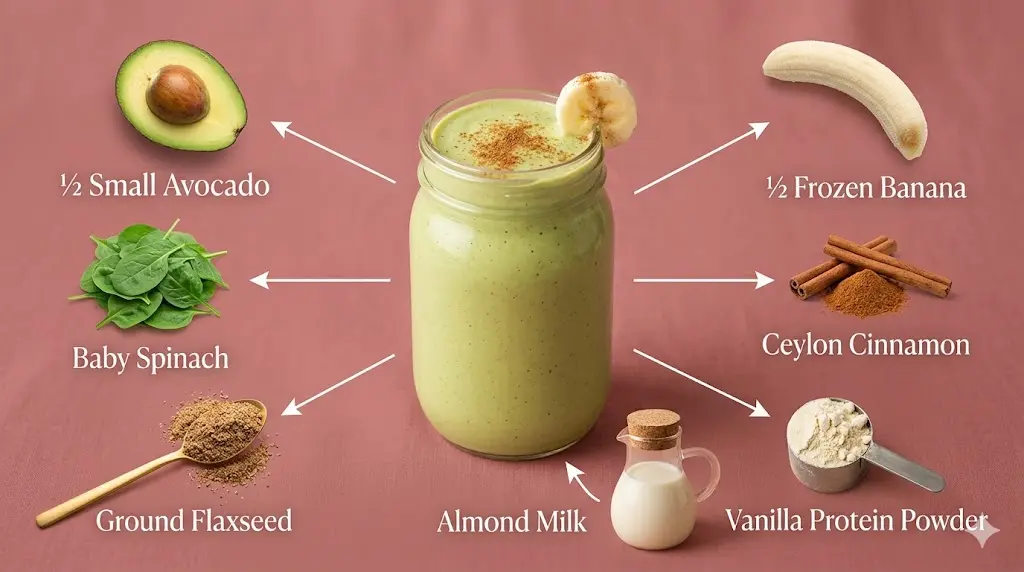
Avocado is one of the most underused ingredients in PCOS smoothies. It provides oleic acid (a monounsaturated fat shown to reduce visceral fat), adds a creamy texture without any dairy, and increases satiety significantly compared to equivalent-calorie carbohydrate sources. (Healthline: Avocado for Weight Loss)
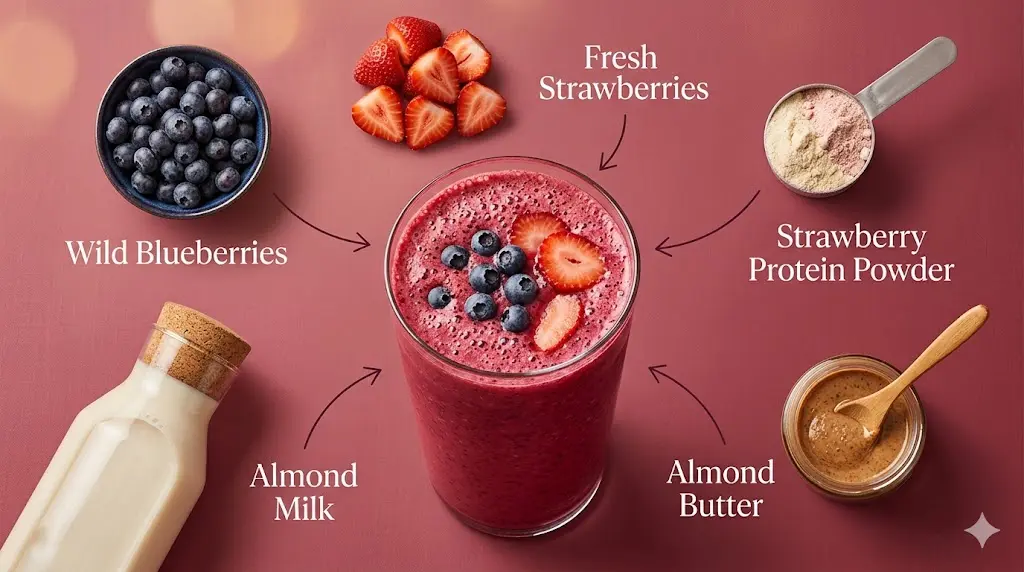
Recipe 3: The GLP-1 Berry Smoothie
- 1 cup unsweetened almond milk
- 1 serving strawberry or vanilla protein powder
- 1 tbsp almond butter
- 1 cup mixed wild blueberries and strawberries
The PCOS Smoothie Formula: 5 Rules That Matter More Than the Recipe
- Never Build Your Smoothie Around Fruit
- Protein Is Non-Negotiable
- Always Add Healthy Fats
- Add Fiber Through Greens or Seeds
- Choose the Right Liquid Base
The Blood Sugar-Balancing Formula
Build every smoothie around this framework:
| Component | Amount | Best Options |
|---|---|---|
| Liquid | 1 cup | Unsweetened almond, coconut, or macadamia milk |
| Fiber | 1–2 tbsp | Ground flaxseed, chia seeds, hemp seeds |
| Healthy fat | 1 tbsp | Almond butter, peanut butter, ¼ avocado |
| Protein | 20–30g | Plant-based or whey protein powder |
| Fruit | Max ½ cup | Blueberries, raspberries, strawberries |
| Flavor booster | ½ tsp | Ceylon cinnamon, raw cacao, ginger |
Ingredients to Avoid in PCOS Smoothies
This section might be the most important in the article. I’ve seen so many “PCOS-friendly” smoothie lists online that are actually landmines for insulin resistance. Here’s what to skip:
- Fruit juices and liquid sweeteners. Orange juice, apple juice, honey, agave, maple syrup.
- High-GI fruits in large quantities. Ripe banana (use only half, frozen), mango, pineapple, grapes, and watermelon.
- Conventional protein powders with artificial sweeteners. Sucralose, acesulfame-K, and aspartame may disrupt gut bacteria and potentially worsen insulin sensitivity with chronic use.
- Flavored yogurt as a base. Low-fat flavored yogurts can contain 15–25g of sugar per serving. Use plain Greek yogurt or plain kefir only.
- Store-bought “green” or “wellness” smoothies. I cannot stress this enough. I’ve looked at the ingredient labels of popular bottled green smoothies, and many of them list apple juice or cane sugar as a primary ingredient. They’re marketed as healthy; the nutrition label tells a different story.
Best Time to Drink PCOS Smoothies for Weight Loss
Timing isn’t everything, but it’s not nothing either — especially for a body managing insulin resistance.
- Morning (on an empty stomach as breakfast): This is the optimal window. Starting the day with a high-protein, high-fiber smoothie instead of skipping breakfast (which spikes cortisol) or eating cereal (which spikes insulin) sets a stable blood sugar baseline.
- Post-workout (within 30 minutes): After strength training or resistance exercise, muscles are primed to absorb glucose without needing excess insulin. A post-workout smoothie with protein (for muscle repair) and a small amount of carbohydrate (from berries) is metabolically ideal.
- Mid-afternoon (instead of a sugar snack): The 3pm energy crash is insulin resistance in action. If you’d otherwise reach for a biscuit or a sweet coffee, an afternoon smoothie is a massive upgrade. The protein and fat will carry you through to dinner without the subsequent crash.
What I’d avoid: Drinking a smoothie alongside a high-carb meal (it compounds the glucose load) or right before bed (you want to give your body a 10–12 hour overnight fast if possible to support insulin sensitivity).
Conclusion
Here’s what I want to leave you with: managing PCOS belly fat is harder than it is for people without this condition, and that’s not in your head. The biology is real, the insulin resistance is real, and the frustration you feel when conventional advice doesn’t work is completely valid.
But the same biology that makes this harder also makes it specific. You now know exactly what drives the problem (insulin resistance + excess androgens), and you have a precise framework for addressing it through what you eat. A smoothie built on protein, healthy fat, and fiber isn’t just a meal — it’s a daily signal to your body that you’re supporting it, not fighting it.
Start with one recipe this week. Build the habit before you optimize the formula. And be patient with your body — it’s been working harder than it should have to for a long time.
FAQs
Which smoothie is best for burning PCOS belly fat?
No single smoothie burns belly fat — but the combination that comes closest to a targeted approach is a high-protein (25g+), high-fiber blend with ½ cup blueberries, 1 tbsp ground flaxseed, 1 tbsp almond butter, and unsweetened almond milk as the base. Blueberry anthocyanins have shown specific effects on reducing visceral adiposity, and the protein-fat-fiber combination directly targets insulin resistance, which is the root driver of PCOS belly fat. Add ½ tsp Ceylon cinnamon for additional insulin sensitivity support.
What makes a smoothie PCOS-friendly?
A genuinely PCOS-friendly smoothie has three non-negotiables: protein (20–30g), healthy fat (1–2 tbsp), and fiber (from seeds or greens). These three work together to slow glucose absorption, prevent an insulin spike, and suppress hunger hormones for several hours. A low-glycemic fruit base (berries, not mango or pineapple) completes the formula. What it does not have: fruit juice, liquid sweeteners, flavored yogurt, or a fruit-to-everything-else ratio greater than 1:2.
Are smoothies bad for PCOS?
The honest answer is: it depends entirely on what’s in them. After going through research and reading through dozens of real-world experiences from women managing PCOS, the consensus is clear: a poorly built smoothie (fruit-heavy, low-protein, juice-based) behaves like a sugar delivery system and makes insulin resistance worse. A properly built smoothie (protein + fat + fiber + low-GI fruit + unsweetened liquid) is a genuinely useful tool for blood sugar management, hormone support, and reducing PCOS symptoms. The smoothie itself is neutral. The ingredients determine everything.
This article is for informational purposes only and does not constitute medical advice. Always consult with a healthcare provider or registered dietitian before making significant dietary changes, especially if you are managing a diagnosed condition like PCOS.
← Back to all posts