Strength Training For Perimenopause
Key Takeaways
- Heavy strength training is one of the most effective tools for managing perimenopause symptoms.
- Compound movements matter more than endless cardio or “light toning” workouts.
- Consistency beats perfection.
You’re probably experiencing a softer middle, slower recovery, joints that protest on cold mornings, energy that vanishes before dinner.
You may have tried moving more, cutting carbs, eating healthy. And yet nothing clicked the way it used to.
The problem isn’t your effort. It’s your strategy.
Perimenopause does not rob you of your ability to build muscle. Lower body strength and hip function improved massively even in women actively going through the transition.
This guide breaks down exactly what’s happening in your body, what to do about it, and how to start — even on the days you’d rather not.
Should You Lift Heavy or Light Weights in Perimenopause?
Heavier than you’re probably lifting right now. Why?
Estrogen directly communicates with myosin — the contractile protein that generates explosive muscle force. When estrogen fluctuates in perimenopause, myosin function degrades, and you lose power before you lose visible muscle mass. That’s why the jar feels heavier. Why stairs feel steeper. Why your body feels softer even when the scale hasn’t changed much.
Heavy Resistance Training for Perimenopause
Move 1: The Hip Hinge — Romanian Deadlift
How to perform (RDL):
- Stand with feet hip-width apart, dumbbells in front of your thighs
- Soft bend in the knees — they stay this way throughout, not deeply bent
- Push your hips back (think: closing a car door with your hips, not bending forward)
- Lower the weights along your legs, feeling a deep pull in your hamstrings
- Stop when you feel a strong stretch — usually mid-shin for most women
- Drive through your heels and squeeze your glutes to stand upright
- Keep your chest proud the entire time; do not let your lower back round
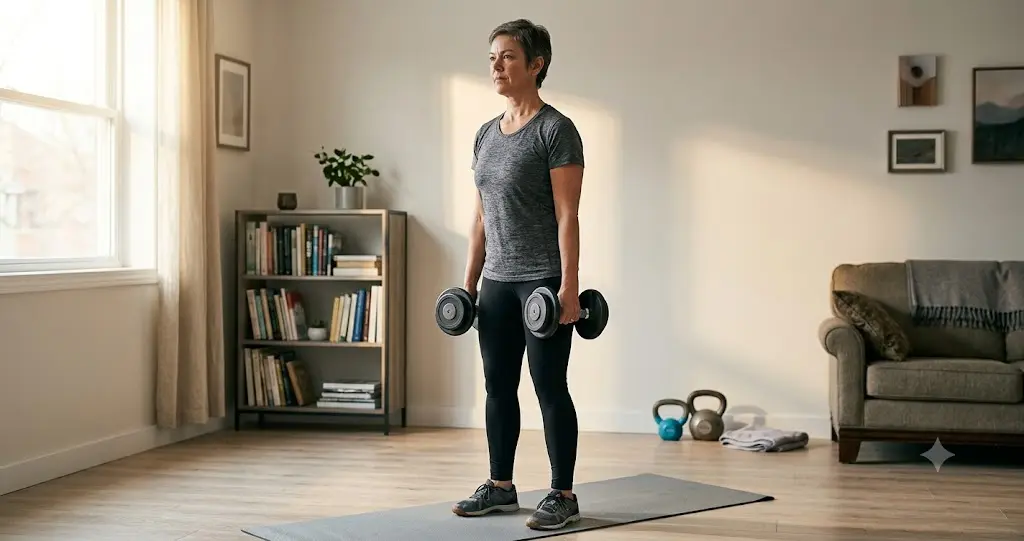
What you should feel: A deep hamstring stretch on the way down. Full glute contraction at the top. Your lower back is engaged but not strained — if it’s aching, the weight is too heavy or your hips aren’t hinging enough.
How this helps: The hip hinge is the most powerful posterior chain movement you can do. It loads the hamstrings, glutes, and lower back simultaneously — the exact muscles that decline fastest in perimenopause and contribute directly to the soft, unsupported lower body many women describe.
Heavy hip hinges also place compressive load on the lumbar spine and hip, one of the most effective non-impact stimuli for bone density in the areas most vulnerable to osteoporosis.
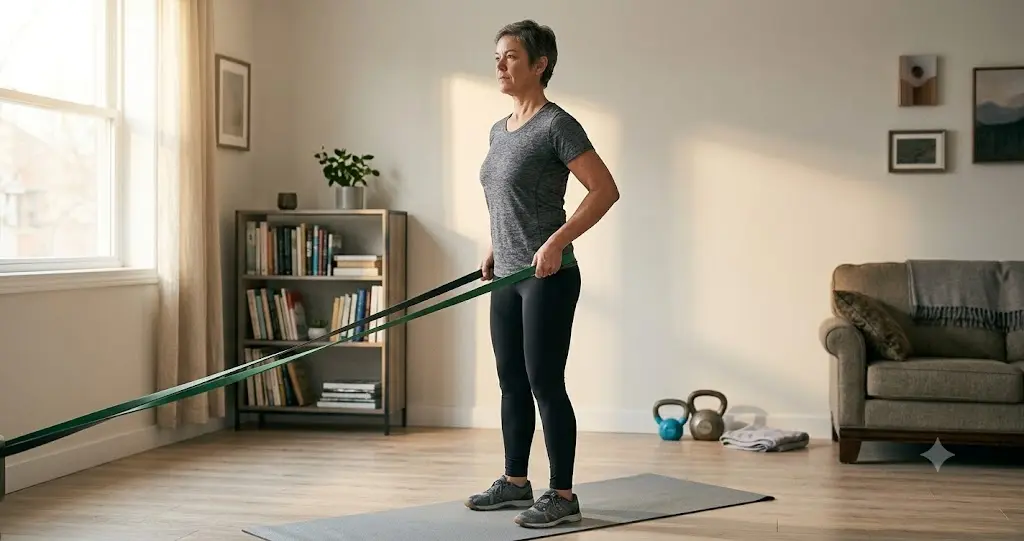
Alternatives for joint sensitivity or beginners: Resistance band hip hinge — Same exact pattern, zero load; a safe way to groove the movement before adding dumbbells
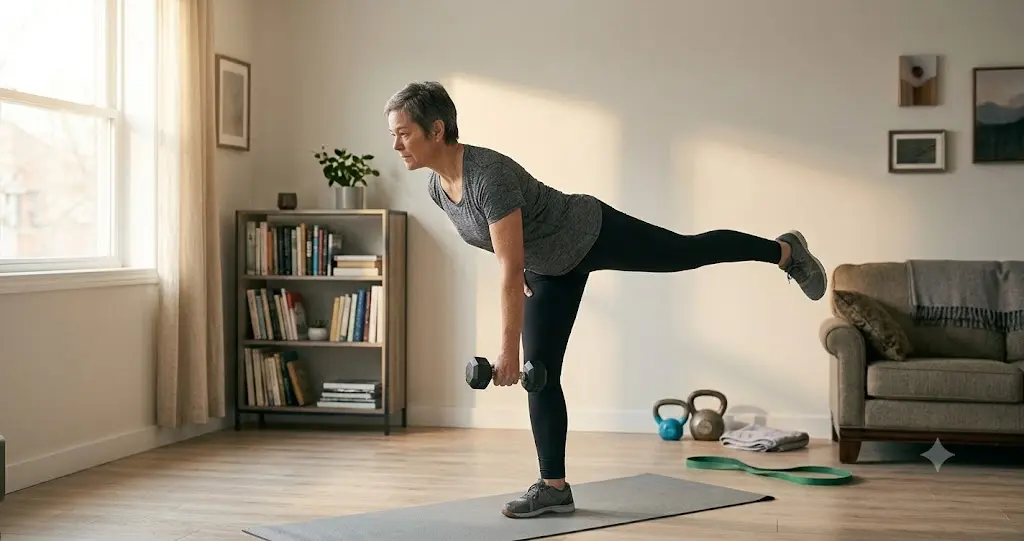
Single-leg RDL — Lighter load on one leg at a time; improves hip stability and reduces spinal compression
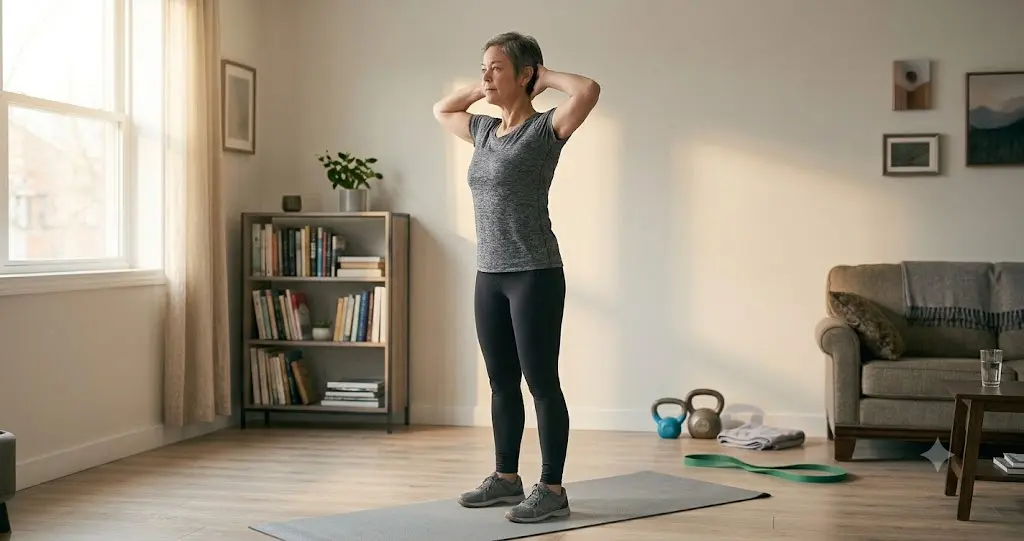
Bodyweight good morning — Hands behind your head, hinge at hips; pure form practice before touching any weight
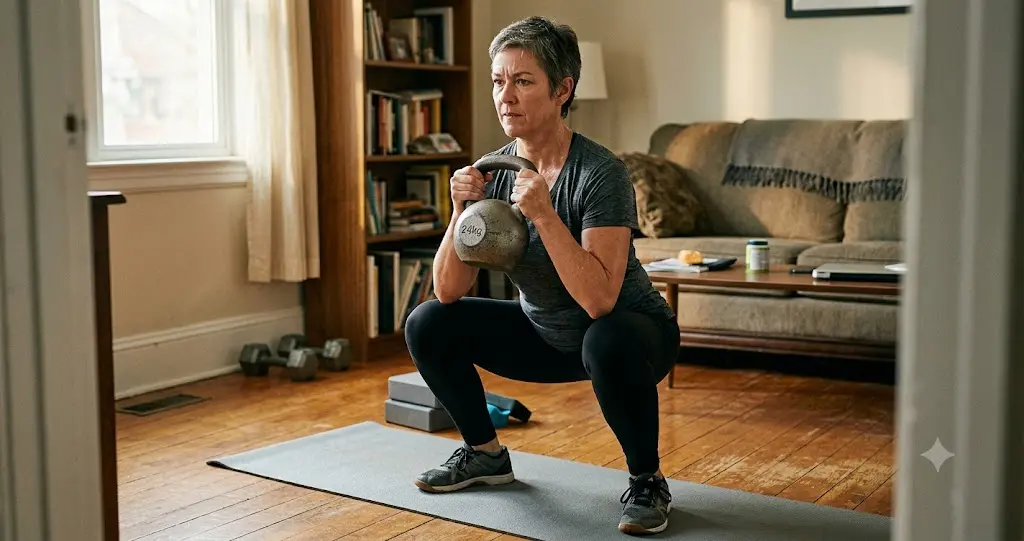
Move 2: The Squat — Goblet Squat
How to perform:
- Hold a single dumbbell vertically at your chest with both hands
- Feet shoulder-width apart, toes turned out 15 to 30 degrees
- Push your knees outward — tracking over your second toe — as you descend
- Lower until thighs are parallel to the floor, or slightly above if your knees protest
- Keep your chest upright; the weight in front of you acts as a natural counterbalance
- Drive through your heels to stand, squeezing your glutes at the very top
- Do not let your knees cave inward on the way back up
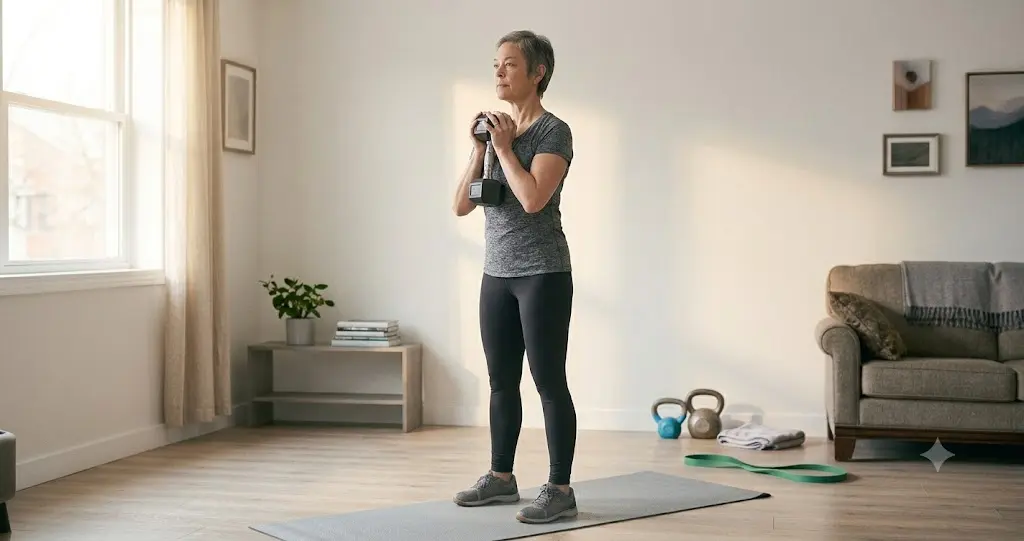
What you should feel: Quads burning on the way down. Glutes firing on the way up. Weight evenly distributed across your whole foot — not tipping forward onto your toes.
How heavy: Hold a dumbbell heavy enough that reps 4 and 5 require real effort. When the set starts to feel manageable, increase the weight — not the reps.
How this helps: Squats load the quads, glutes, and hip flexors — the three muscle groups most directly linked to lower body power. Heavy squatting also generates significant bone-loading force through the femur and tibia, the two sites where osteoporosis most commonly develops in women post-perimenopause.
Alternatives for knee pain:
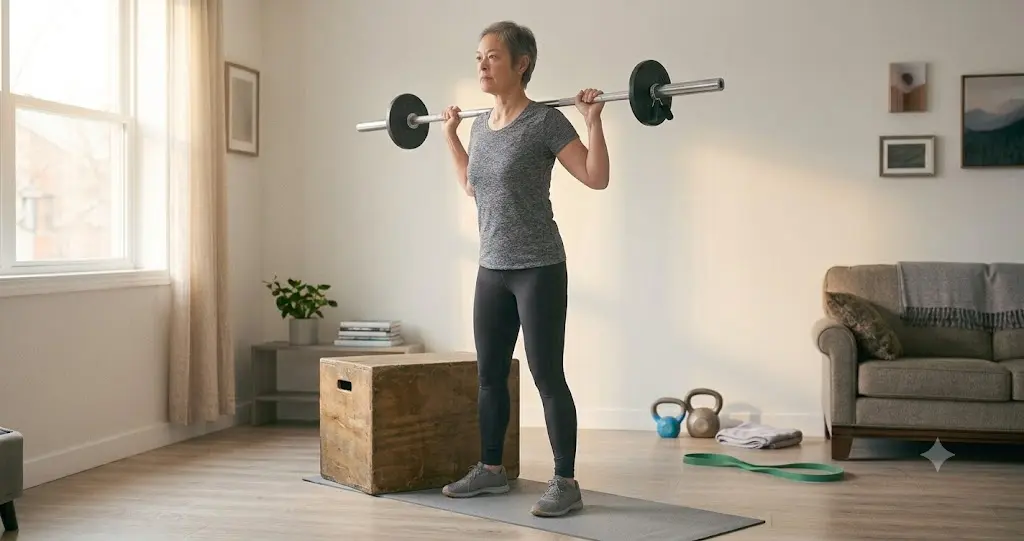
Box squat — Squat down to a chair or low box, pause, then stand; limits depth and dramatically reduces knee stress
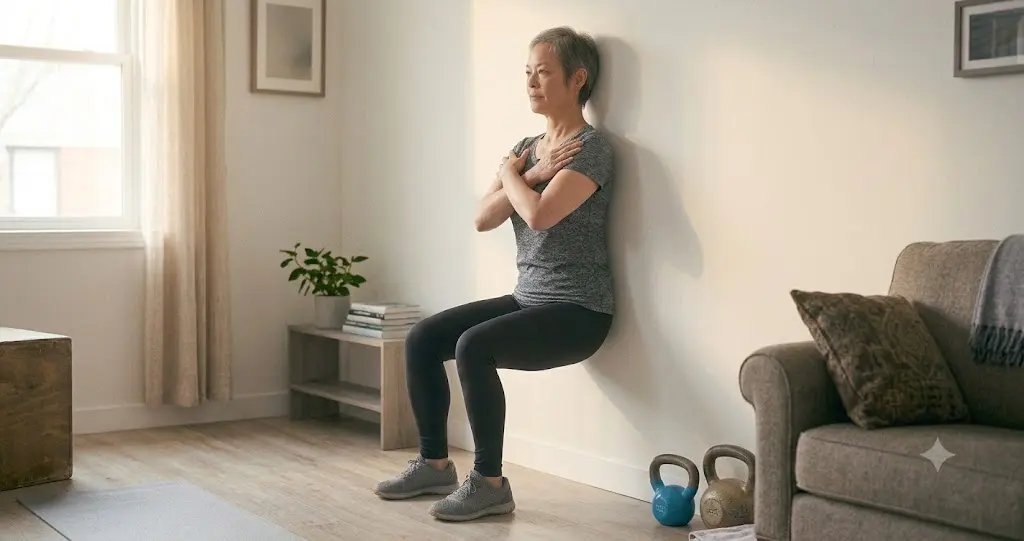
Wall sit (isometric) — Hold a static squat against the wall; builds quad strength without joint movement at all
Step-up — Stepping onto a sturdy box or stair mimics squat mechanics with controlled, unilateral load and no deep knee flexion
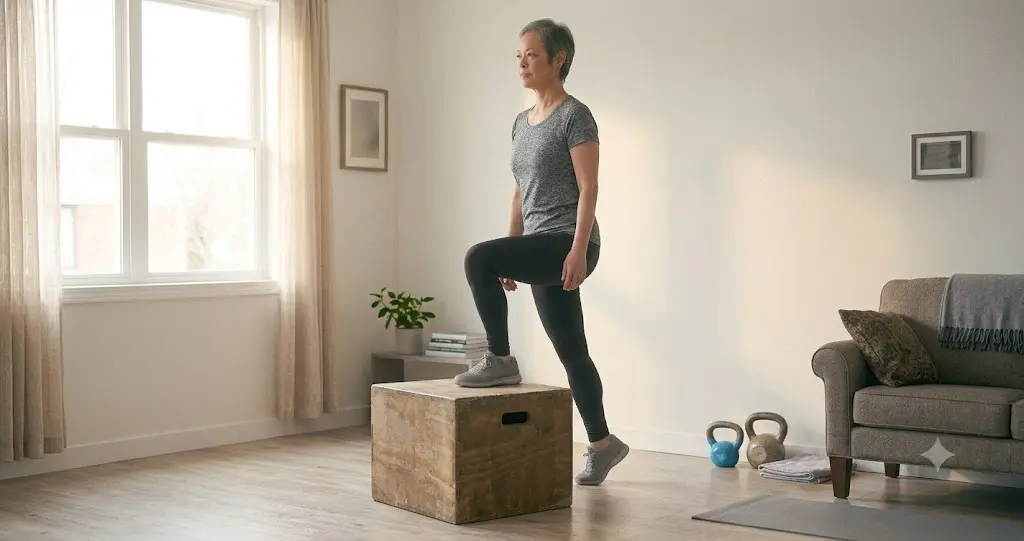
Did You Know? Deborah Taylor, 56, came back to fitness wanting to combat midlife sluggishness. Estrogen decline reduces joint lubrication, and Deborah felt it immediately — standard squats and lunges caused agonizing knee pain. Switching to box squats and step-ups let her keep loading her lower body without quitting. She now refers to lifting as her “fitness preserver.” A joint modification is not a downgrade. It’s how you stay in the game.
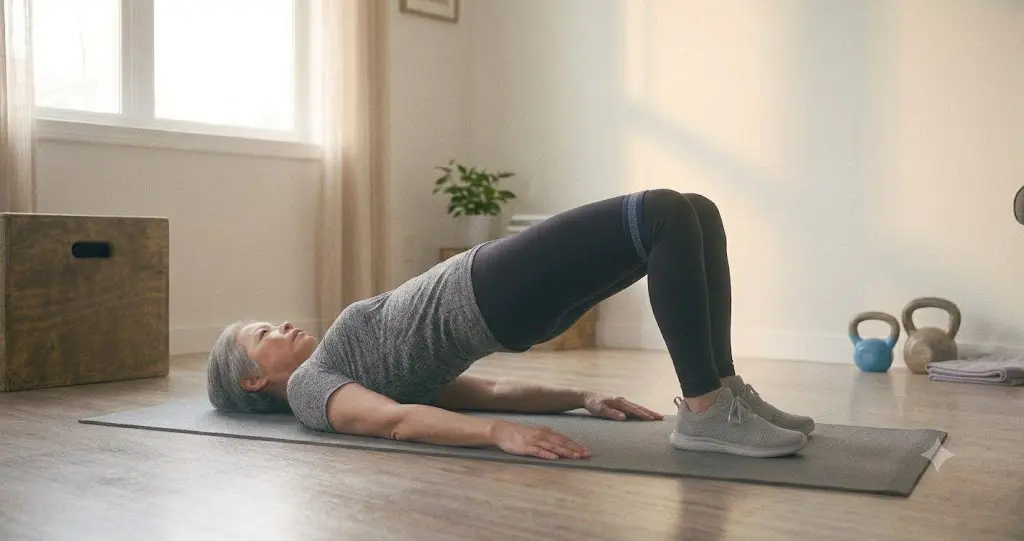
Move 3: The Hip Thrust
How to perform:
- Sit on the floor with your upper back against a couch, bench, or sturdy chair (the edge sits just below your shoulder blades)
- Place a dumbbell across your hip crease — start with bodyweight to learn the movement first
- Feet flat on the floor, knees bent roughly 90 degrees, feet hip-width apart
- Drive through your heels to push your hips upward until your body forms a straight line from knees to shoulders
- Squeeze your glutes hard at the top — hold for one full second
- Lower slowly, 3-count descent, without letting your hips touch the floor between reps — keep the tension constant
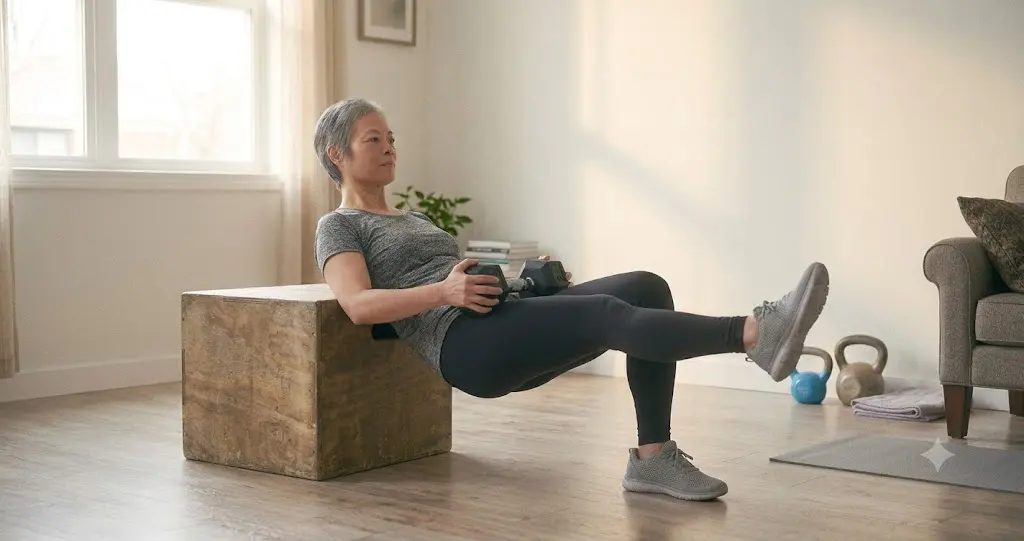
What you should feel: Your glutes doing the majority of the work. If your lower back is taking over, move your feet slightly closer to your body.
How this helps: The hip thrust produces the highest gluteus maximus activation of any lower body exercise — consistently higher than squats or deadlifts in EMG research.
Alternatives:
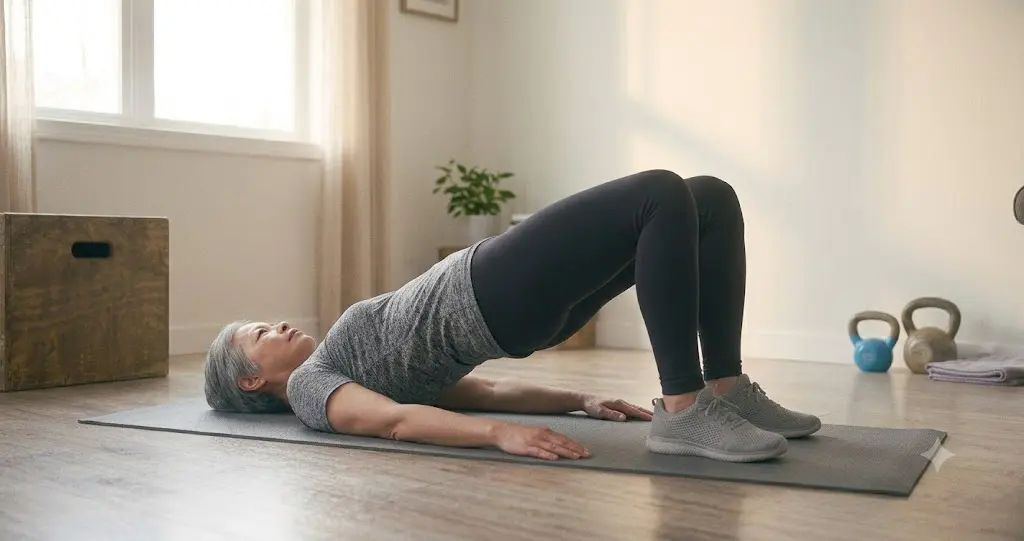
Glute bridge (floor, no bench) — Same movement pattern but lower range of motion; perfect for learning form with zero setup
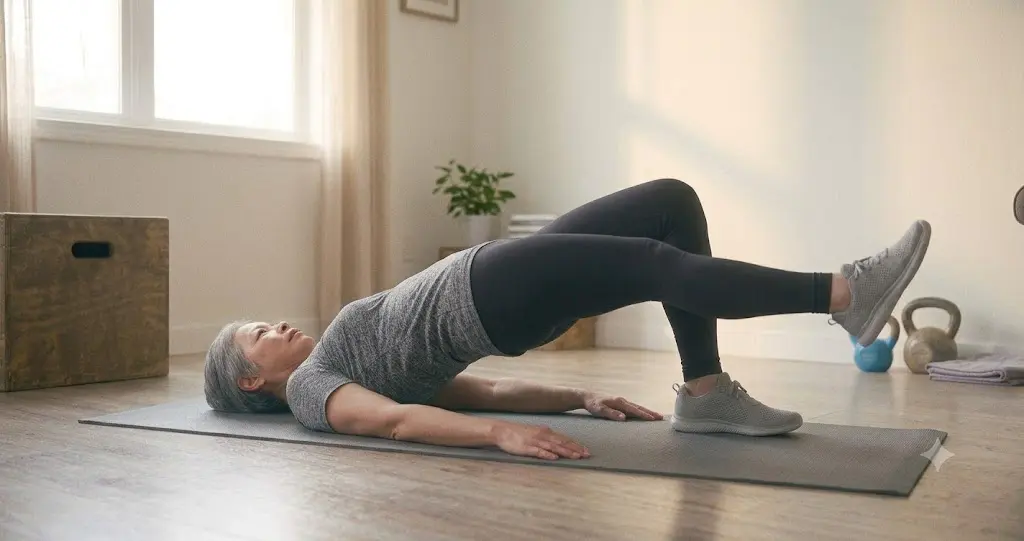
Single-leg glute bridge — Removes the bench, adds intensity by isolating one glute at a time; no equipment needed
Banded glute bridge — Resistance band just above the knees adds hip abductor engagement; great for pelvic floor stability, which is directly affected by estrogen decline
Compound Movements: Training Patterns, Not Just Exercises
If heavy resistance training is how hard you load, compound movements define what you load.
Every major functional pattern maps to a compound movement:
| Daily Movement | Compound Exercise |
|---|---|
| Getting up from a chair / floor | Squat |
| Picking up something heavy | Hip hinge / Deadlift |
| Pushing a door, cart, or stroller | Push-up / Chest press |
| Pulling a bag, seatbelt, or drawer | Row |
| Reaching to a high shelf | Overhead press |
| Carrying groceries, a bag, a child | Farmer carry |
You do all of these every single day. You should train all of them every week.
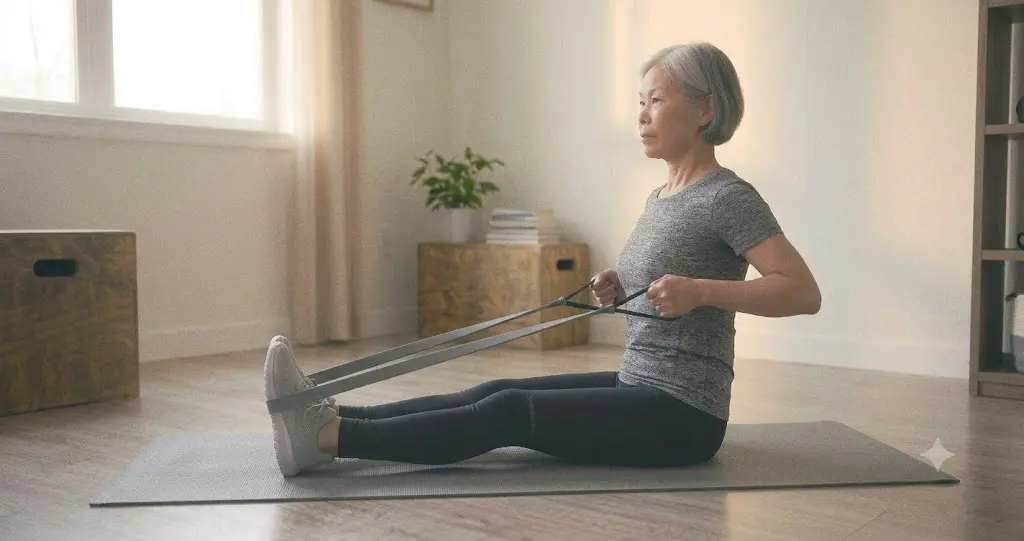
Compound Movement 1: The Row — Horizontal Pull
How to perform — Dumbbell Bent-Over Row:
- Stand with feet hip-width apart, soft knee bend
- Hinge forward at the hips — torso roughly 45 to 60 degrees to the floor
- Hold a dumbbell in each hand, arms hanging straight from your shoulders
- Pull the dumbbells toward your hips, not your chest — elbows drive straight back
- Squeeze your shoulder blades together at the top of the row
- Lower slowly on a 2 to 3-count — the descent builds as much muscle as the pull
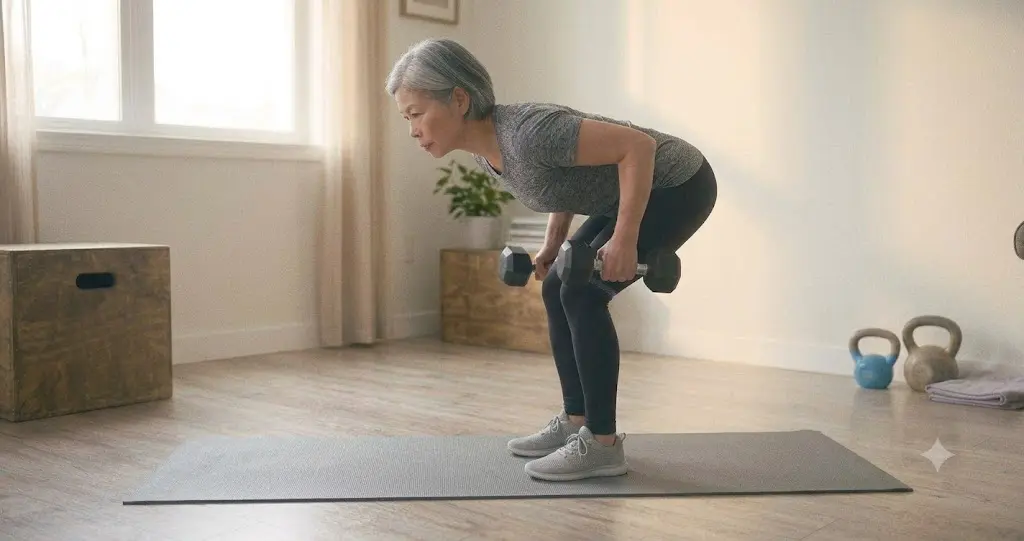
What you should feel: Your mid-back doing the primary work. Biceps will assist — that’s normal and correct. If your lower back is aching, you’re hinging too deep or the weight is too heavy.
How this helps: Rows rebuild the muscles that hold you upright. They are posture work and bone health work at the same time.
Alternatives:
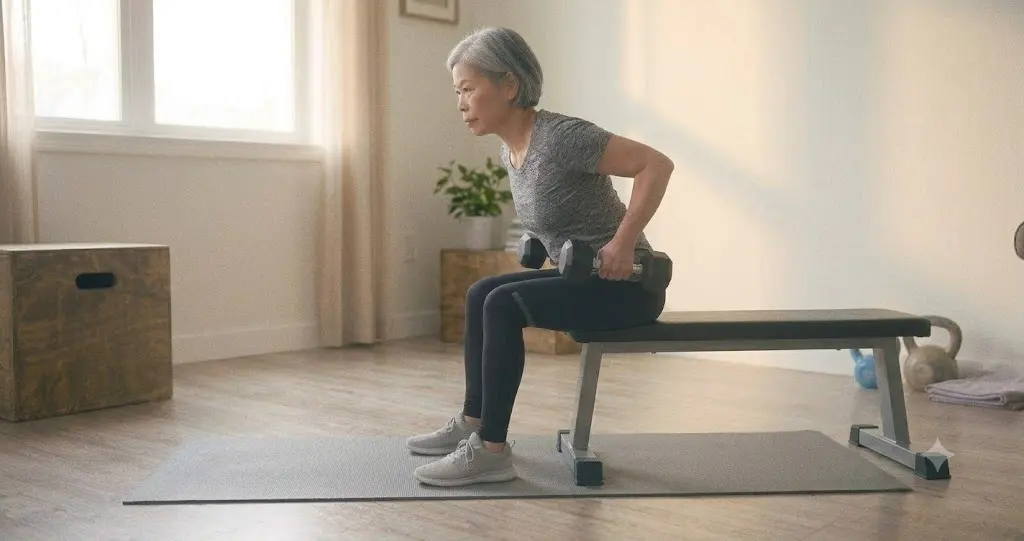
Seated dumbbell row — Sit at the edge of a sturdy chair, hinge forward from the hips, row; removes all lower back stress from the equation
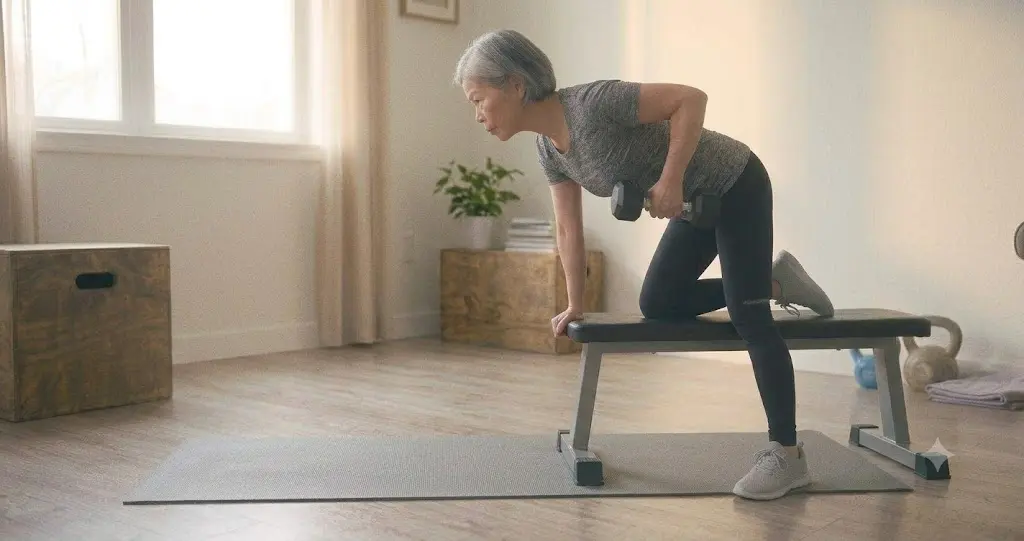
Single-arm supported row — Rest one hand on a table or the back of a couch; this completely eliminates lumbar strain and lets you pull heavier with better form
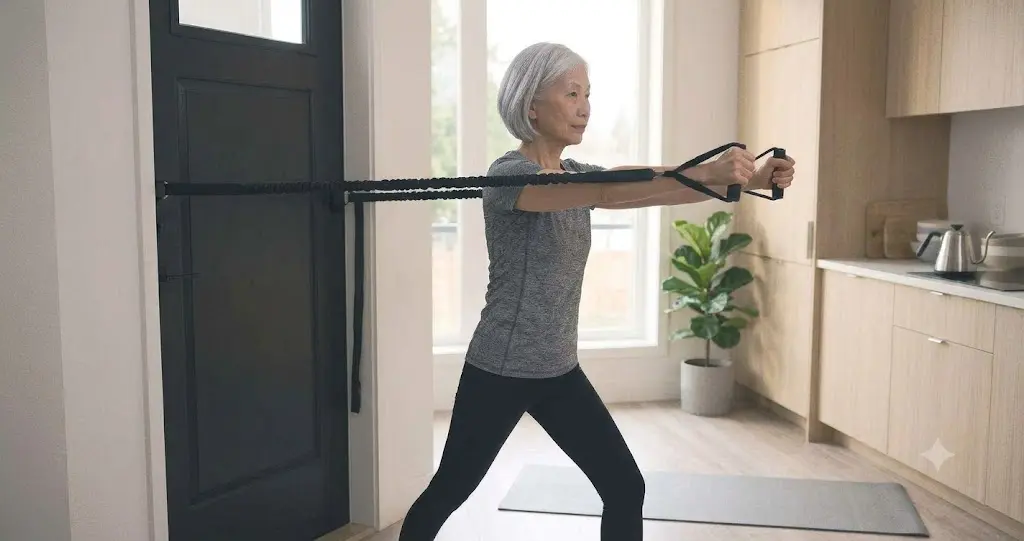
Resistance band row — Anchor a band at hip height around a door handle or post; pull both handles toward your hips; fully adjustable load, zero joint impact, can be done anywhere
Compound Movement 2: The Push — Chest Press and Push-Up
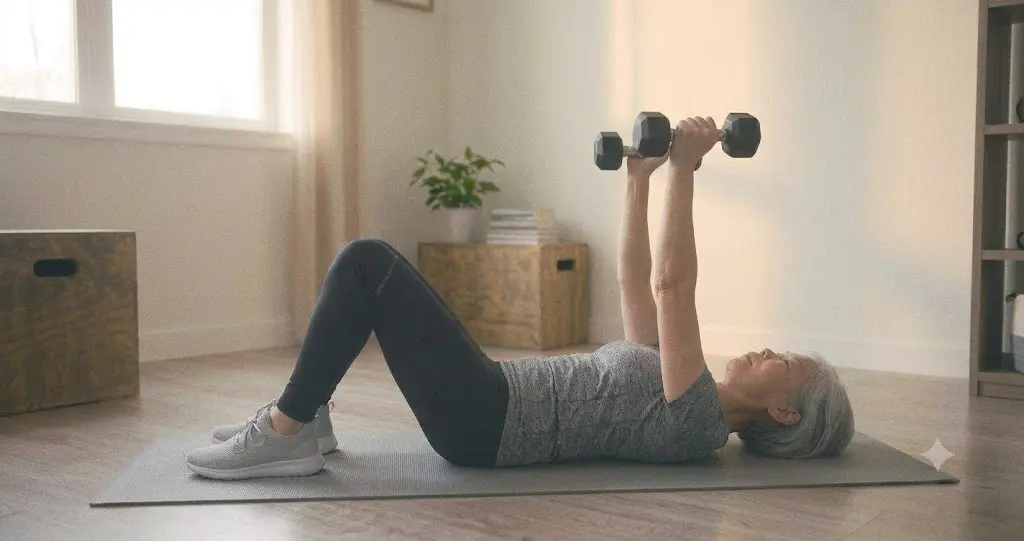
How to perform — Dumbbell Chest Press:
- Lie on your back on the floor (or a bench if you have one)
- Dumbbells held at chest level, elbows at 45 degrees from your torso — not flared out wide
- Press the weights upward until your arms are nearly straight; avoid fully locking elbows
- Lower slowly until elbows lightly touch the floor (floor press) or just below chest height (bench)
- Pause briefly at the bottom before pressing again — this removes momentum and maximizes muscle demand
How to perform — Push-Up:
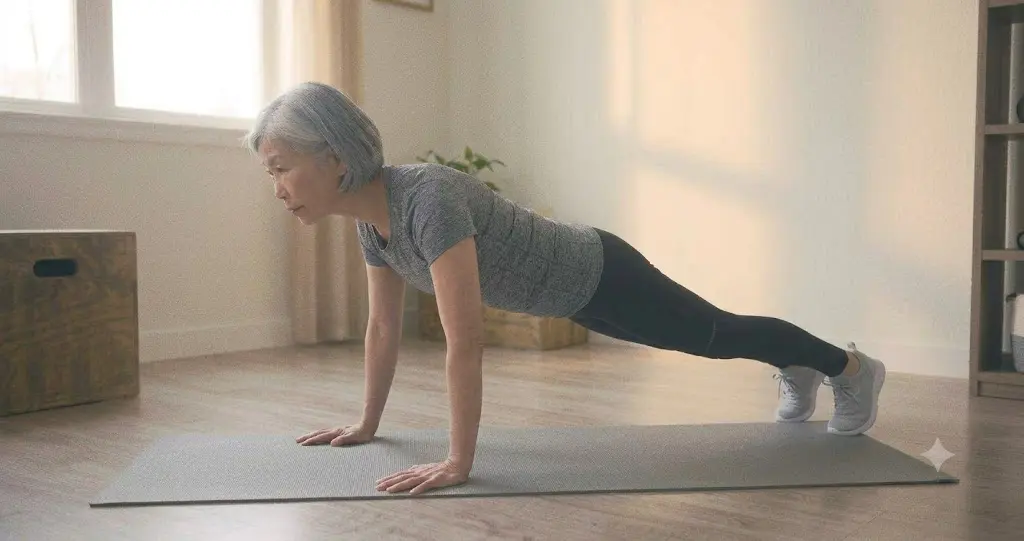
- Hands slightly wider than shoulder-width, fingers spread
- Body in a straight line from crown to heels (or knees for modified version)
- Lower your chest toward the floor — elbows track at 45 degrees, not flared out to the sides
- Push the floor away from you on the way up — full arm extension, stopping just before elbows lock
What you should feel: Your chest engaging at the bottom of the press. Shoulders and triceps supporting at the top. If only your triceps are working, the weight is too heavy — drop it and focus on feeling the chest.
How this helps: Pushing strength is one of the first things women notice declining in perimenopause — a door that requires more effort, a bag that’s harder to lift, trouble pushing up from the floor.
Progressive pressing movements train the chest, anterior deltoids, and triceps, and when loaded consistently, chest presses stimulate bone density in the sternum and clavicle — two areas almost never mentioned in bone health conversations but genuinely affected by estrogen loss.
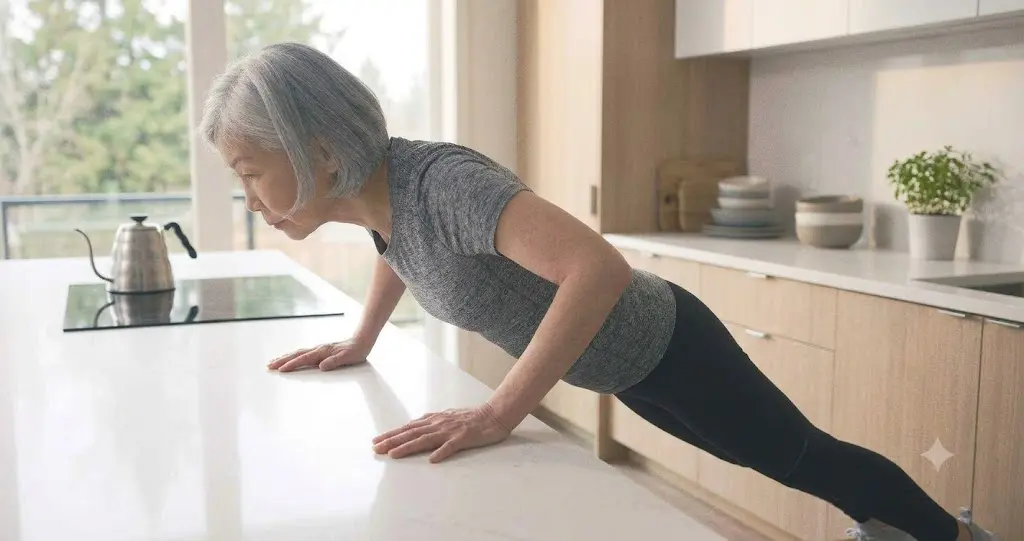
Alternatives: Incline push-up (hands on counter or wall) — Reduces bodyweight load significantly; a real starting point for beginners, not a cop-out
Dumbbell floor press — Identical to bench press but on the floor; limits range of motion, protects shoulders for anyone with joint sensitivity
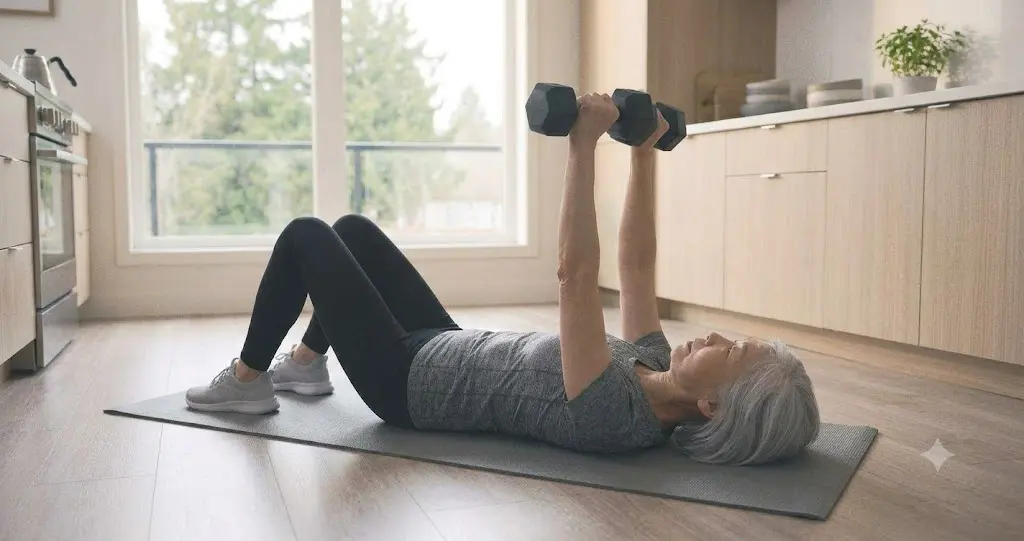
Resistance band chest press — Anchor a band behind you at chest height, press forward; smooth constant tension with no joint compression at all
The overhead press — why include it:
Standing or seated dumbbell press (weights from shoulders to overhead) trains the deltoids and upper traps, which govern your ability to reach safely overhead.
It also loads the cervical and upper thoracic spine — areas estrogen decline leaves particularly vulnerable to bone loss. Keep weight light enough for 6 to 8 clean reps with full range of motion, and build from there. The overhead pattern is worth training weekly.
Compound Movement 3: The Farmer Carry
This gets no attention in most perimenopause fitness content. It deserves to be central. It also mimics the most common real-life load you carry: grocery bags.
How to perform:
- Pick up heavy dumbbells — heavier than feels comfortable. This should be genuinely effortful to hold
- Stand tall, shoulders pulled back and down away from your ears
- Walk 20 to 30 meters, or across your room and back repeatedly, for 30 to 45 seconds
- Keep your ribcage stacked over your hips — do not lean to either side
- Breathe normally throughout. Never hold your breath under a carry
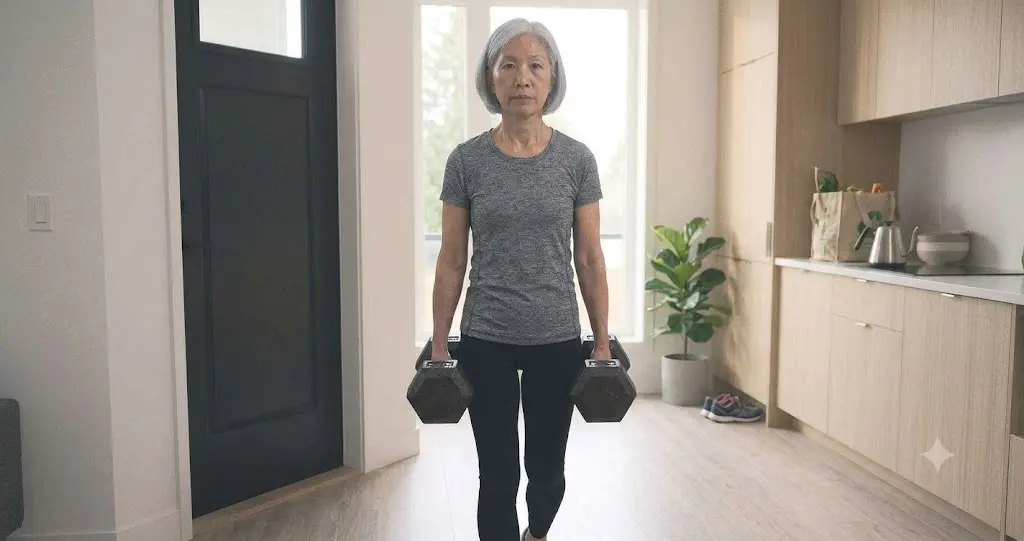
What you should feel: Forearms working hard, core bracing to stay upright, upper back preventing your shoulders from rounding forward. If you’re wobbling or leaning, the weight is too heavy.
How this helps: Walking while carrying heavy weights trains grip strength, core stability, shoulder packing, and hip stability all at once — under real load, in real time. Grip strength in midlife women is a direct predictor of independence and fall prevention.
Alternatives: Suitcase carry (one side only) — Hold weight on one side only; forces your core to work much harder to keep your spine level; excellent for obliques and hip stability
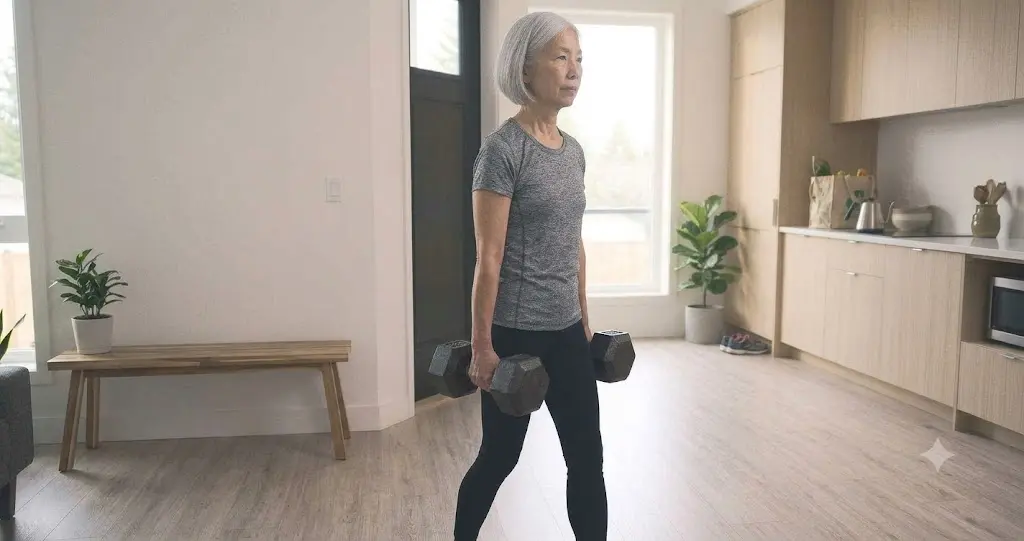
Goblet carry — Hold a single heavy dumbbell at chest level and walk; increases core demand while reducing grip demand; great entry point
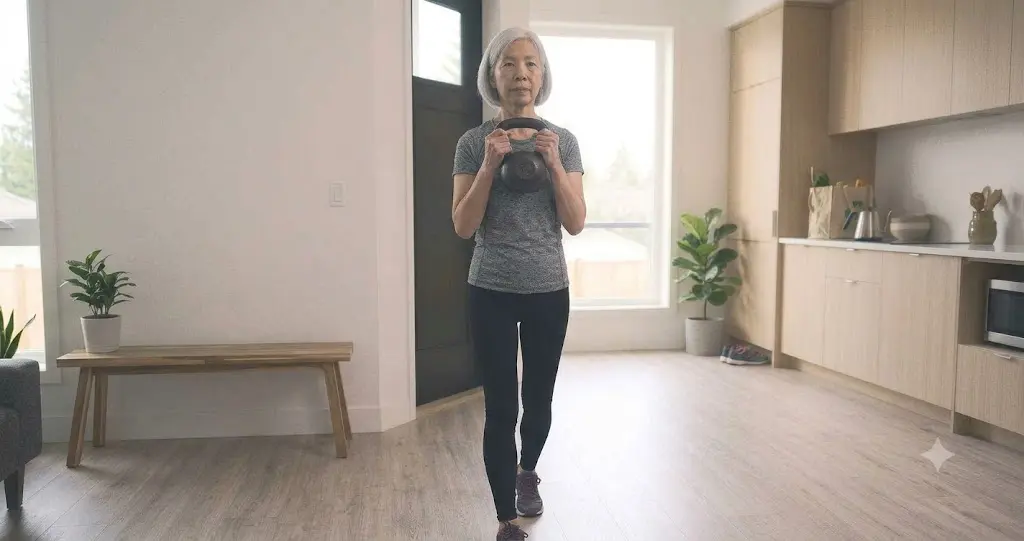
How Many Days a Week Should You Strength Train?
2 to 3 full-body sessions per week is the evidence-based sweet spot for most women.
| Training Frequency | Best For |
|---|---|
| 2 full-body sessions/week | Beginners, high-stress periods, poor sleep weeks |
| 3 full-body sessions/week | Most women — ideal balance of stimulus and recovery |
| 4 split sessions/week | Experienced lifters with solid sleep and low cortisol |
The key rule: leave at least one full rest day between lifting sessions.
A survey reported women in perimenopause urgently want to do high-intensity resistance training — primarily to protect their bones. Yet the vast majority weren’t actually doing it. They were walking and cycling. Not from lack of desire, but from lack of a clear, accessible starting point.
That starting point is 2 days a week, at home, with dumbbells.
Can Strength Training Actually Change How Perimenopause Feels Day to Day?
Yes — and the evidence goes far beyond just body composition.
Forget just tracking your waistline. Lifting heavy is a scientifically backed, non-pharmacological shield against some of the most disruptive symptoms of perimenopause.
Sharon Ketley hit 51 feeling chronically sluggish, disconnected from her body, and low-energy. She’d spent her life avoiding exercise — convinced weights would make her look “bulky” or masculine.
Desperate for a change from her low mood, she finally started a strength program tailored for menopause. Three months in, the word she used was epiphany. While her body firmed up, the unexpected mental shift was the real win. She conquered the gym intimidation, felt a surge in daily energy, and said her progress put a spring in her step.
Sharon didn’t expect the mood shift to arrive first. Most women don’t.
The Cardio Trap That Stopped Working
Tired of this jargon? Walk more. Cycle more. Run more. Burn more.
But chronic cardio doesn’t fix myosin dysfunction. It doesn’t stimulate the hormonal signaling needed for muscle protein synthesis. It doesn’t rebuild bone. It burns calories, yes — but in perimenopause, your body is losing structural capacity, not just storing extra energy.
A Realistic 3-Day Home Workout Plan
You don’t need a gym. You need dumbbells — or even bodyweight to start — and about 25 to 35 minutes.
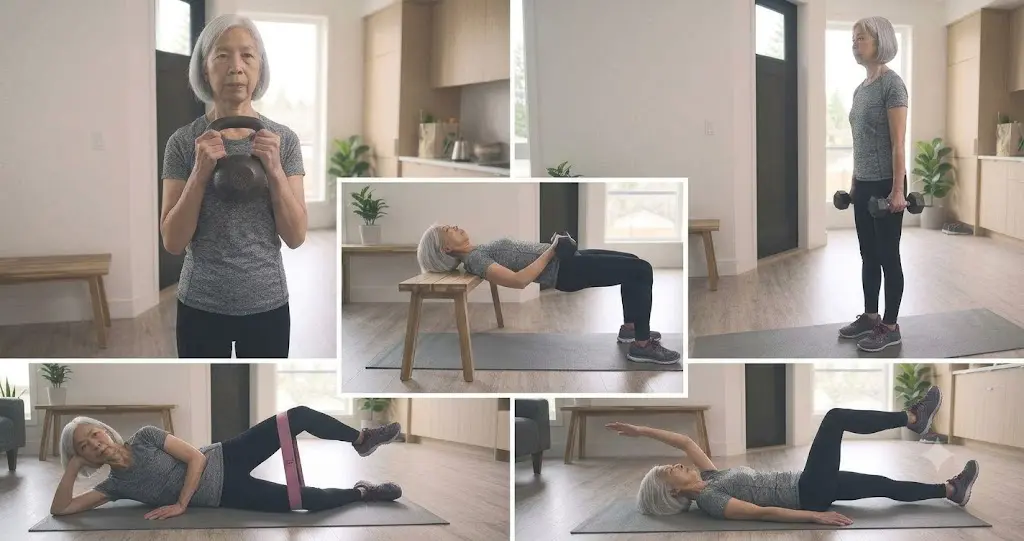
Day 1 — Lower Body + Core
- Goblet squat: 3 × 8–10
- Romanian deadlift: 3 × 8–10
- Hip thrust: 3 × 10–12
- Side-lying clam (pelvic floor and hip stability): 3 × 15 per side
- Dead bug: 3 × 8 per side
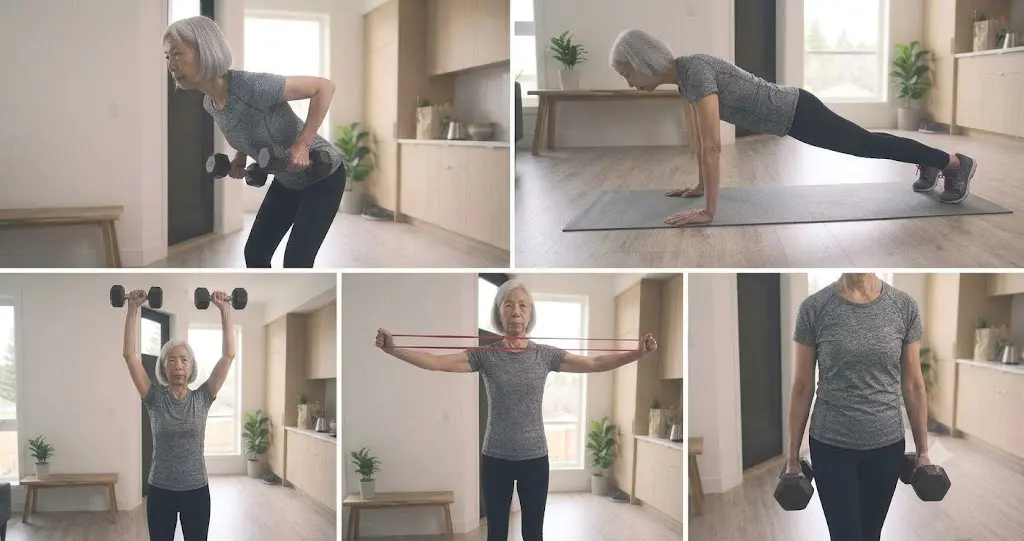
Day 2 — Upper Body + Pulling
- Dumbbell bent-over row: 3 × 8–12
- Push-up or dumbbell chest press: 3 × 8–10
- Dumbbell shoulder press: 3 × 8–10
- Band pull-apart or lat pulldown: 3 × 10–12
- Farmer carry: 3 rounds × 30 seconds
Day 3 — Full Body + Power
- Loaded step-up: 3 × 8 per leg
- Deadlift variation: 3 × 5–8 (heavier; last 2 reps hard)
- Incline dumbbell press: 3 × 8–10
- Reverse lunge: 3 × 8 per leg
- Jump squat or brisk stair climbing: 2 × 10 reps (if joints allow)
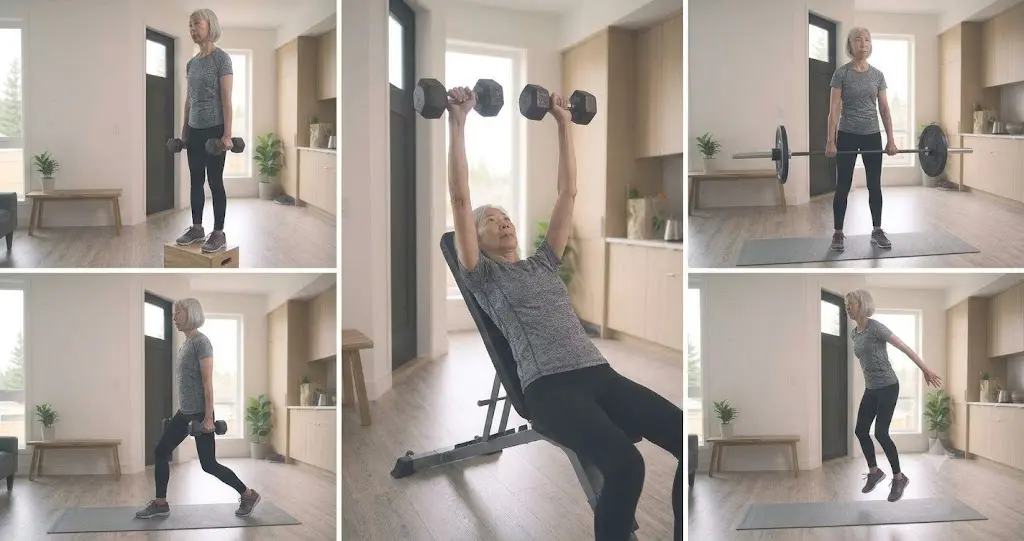
The power component on Day 3 isn’t optional decoration. Bone responds best to both resistance and impact loading. If jump squats aren’t right for your knees, brisk stair climbing or high-knee marching accomplishes the same bone stimulus with far less joint shear. Either works.
What to Expect — A Realistic Week-by-Week Timeline
Progress in perimenopause doesn’t always look like the before-and-after photos promise. But it’s real, and it accumulates.
| Weeks | What You’ll Likely Notice |
|---|---|
| 1–3 | Joints feel more mobile; morning stiffness decreases; soreness fades faster |
| 4–6 | Carrying groceries, lifting bags, climbing stairs feels noticeably easier |
| 7–9 | Hot flashes may pass more quickly and land less intensely |
| 10–12 | Body composition shifts become visible; energy is more consistent throughout the day |
Mistakes That Slow Your Progress
- Lifting weights that are too light
- Switching programs before they work
- Undereating protein
- Doing all cardio, no lifting
- Training hard through chronic poor sleep
Is Your Training Actually Working for Perimenopause?
| Question | If Yes | If No |
|---|---|---|
| Are you lifting at least 2× per week? | Keep going | Add one session this week |
| Do your last 2 reps feel genuinely hard? | Weight is appropriate | Increase by 5–10% |
| Are you eating protein with every meal? | Good muscle support | Add one protein source daily |
| Taking at least 1 rest day between sessions? | Recovery is protected | Add a rest day |
| Have you kept the same program 8+ weeks? | Give it more time | Stop switching |
Conclusion
Your hormones are changing. Your muscles haven’t forgotten how to adapt.
Three things to hold onto: strength training is the most effective non-pharmacological tool you have for managing perimenopause. Heavy compound movements rebuild what estrogen disruption is dismantling. And 8 to 12 weeks of consistent work — not perfect work, just consistent — is where the real shift happens.
You don’t need to overhaul your life. Start with 2 sessions per week, pick a weight that challenges you, and eat enough protein to support what you’re building. That’s the whole plan, and it works.
You’re not starting over. You’re starting from experience.
FAQs
How often should you lift weights in perimenopause?**
2 to 3 full-body sessions per week is the evidence-based starting point. The 2025 University of Exeter study confirmed that this frequency is enough to improve lower body strength and physical function even during active hormonal transition. Beginning with 2 sessions and adding a third once the habit is solid is a reliable approach.
Should you lift heavy or light weights in perimenopause?**
Heavier than you’re probably currently lifting. Perimenopause disrupts myosin, the protein responsible for force generation, and light high-rep training does not fix that. Research supports 4 to 6 reps near failure for neuromuscular adaptation. Practically: your last 2 reps should feel genuinely difficult without breaking form.
Is cardio or weights better for perimenopause?**
Both have a role, but weights take priority in this phase. Cardio supports cardiovascular health and mood. Strength training directly addresses muscle loss, bone density, metabolic shifts, insulin sensitivity, and even hot flash frequency. If you can only do one, lift.
Can you build muscle during perimenopause?**
Yes, fully. The 2025 University of Exeter study — the first to track this specifically — found that perimenopause does not change a woman’s ability to build muscle or increase strength. Women going through the transition improved lower body strength and hip function significantly. The ability is intact; the strategy just needs to match the physiology.
What if you are too tired to work out?**
Do a shorter version — 15 to 20 minutes, 2 exercises, 2 sets each. Showing up with reduced output protects your habit and keeps the adaptation signal going without spiking cortisol further. Missing entirely is harder to recover from (behaviorally) than an easy session.
Does strength training help with hot flashes?**
Yes — specifically resistance training. A 2023 systematic review of 12 randomized controlled trials found that consistent strength training measurably reduced both the severity and frequency of hot flashes in perimenopausal women. This positions it as a viable non-hormonal intervention, not just a fitness tool.
About the Author: I’m a fitness content writer with three years of experience in women’s health and wellness. I lost weight through home workouts and dietary changes alone — no gym, no pills — while navigating acne, hair loss, and the emotional weight of a body in flux. I write for women who want research-backed guidance, not a highlight reel. Everything on this blog is built on science I’ve actually read, not headlines I’ve recycled.
← Back to all posts