Workout Tips For Women Over 40 With Pcos
Key Takeaways
- Build muscle, not burnout: Three beginner strength sessions each week help improve insulin sensitivity and support long-term fat loss.
- Walk smarter: A 10–15 minute walk after meals can help manage blood sugar and complement your strength workouts.
- Start small, stay consistent: Water, walking, and progressive strength training beat extreme diets or exhausting workouts every time.
If you’re 40, have never really worked out, and PCOS feels like it’s working against you - you’re not starting from behind. You’re starting exactly where you should.
Workout tips for a 40-year-old beginner with PCOS come down to three things, not thirty: water, walking, and beginner strength moves.
Not a 6 a.m. bootcamp. Not a meal plan taped to your fridge. Just three habits, done consistently, that actually work with your hormones instead of against them.
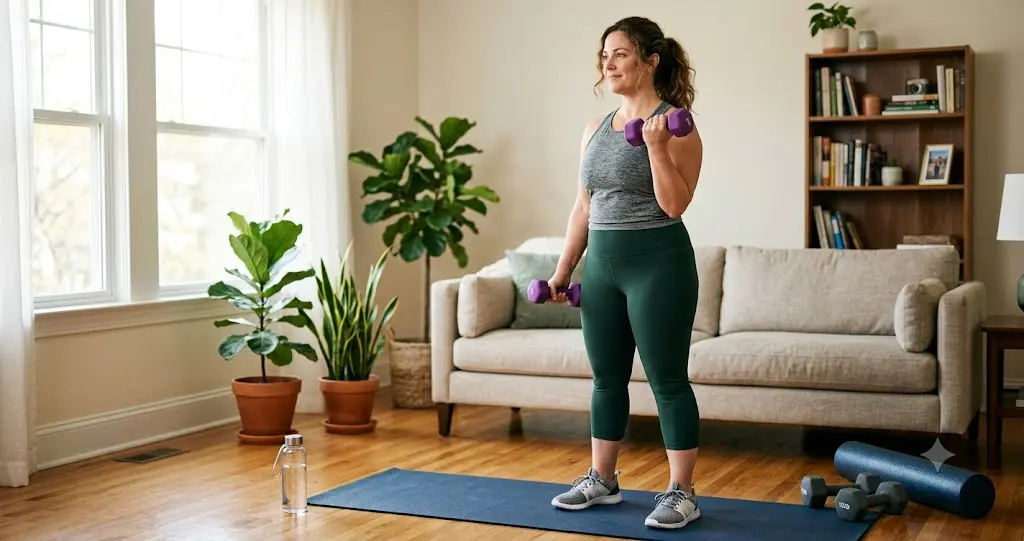
I lost over 30kg starting from the exact same place - no gym, no experience, a living room and some dumbbells. PCOS and being over 40 wasn’t part of my story, but starting from zero was. So let’s start there.
Water: The Foundational Habit Most Beginners Skip
Water matters more than most beginners think, and it’s usually the first habit to slide.
The general daily target for women is around 2.7 liters — about 11.5 cups — from all food and drink combined, per the National Academies of Medicine.
Here’s why it’s not just a wellness-influencer talking point for you specifically:
- Recovery. Dehydration makes soreness worse between your Monday, Wednesday, Friday lifting days — and sore, tired muscles are the first excuse to skip a session.
- Hunger cues. When you’re eating in a deficit, thirst and hunger get tangled up fast. Water helps you tell them apart before you’re standing in front of the pantry at 3 p.m.
- How hard things feel. Even mild dehydration makes your walk and your workout feel harder than they are — and “this feels too hard” is how good habits quietly die.
Skip the electrolyte packets for now. Unless you’re sweating through an intense session or it’s the middle of summer, a normal diet with some fruit and vegetables replaces what you lose just fine.
The easiest fix isn’t a fancy tracker. It’s one glass of water the second you get up — before coffee, before your phone, before the kids need anything. Anchor it there and the rest of the day tends to follow.
One more thing I personally follow is:
If you are feeling hungry, go and grab an apple, if you can eat and finish it, you are hungry, and if you aren’t, then you are simply dehydrated…
Walk: Why It’s the Highest-ROI Move for PCOS Over 40
Walking works — but when you walk matters almost as much as how far.
A short walk right after eating — even ten minutes — helps your muscles pull glucose out of your bloodstream before it has a chance to spike, instead of just circulating and triggering a bigger insulin response.
So instead of one long walk after dinner, try splitting it:
- Ten minutes after lunch
- Ten after dinner, and whatever’s left whenever you can fit it in.
Same total time. Possibly more payoff for your blood sugar.
The CDC recommends at least 150 minutes of moderate activity a week for adults, and your daily mile on the walking pad gets you most of the way there before strength days even count. Good instinct, keep it.
Keep the pace conversational — a 2.8 to 3 mph clip where you could still talk to your kid or take a call. This isn’t the moment to chase intensity.
Consistency is the actual lever here.
Strength Training Moves: Your First Beginner Routine
Diet without lifting, and some of what disappears is muscle and bone you actually wanted to keep.
You don’t need to earn the right to use real weight. Start with what your dumbbell set gives you and let the progress come from showing up, not from pushing too hard too soon.
Here’s the full three-day split, broken down move by move — what it does, how to do it, how much, and what to watch for.
General rules before you start
A few things apply to every move below, so let’s cover them once.
- When to train. Any time of day works, but strength sessions right before or after a meal can pair nicely with your post-meal walk — lift, then walk it off, then eat, or walk after eating and lift a few hours later. Whatever fits your school-pickup schedule is the right time.
- Warm-up. Two to three minutes of marching in place or slow bodyweight squats before you touch a dumbbell. Cold muscles and PCOS-related joint stiffness don’t mix well.
- Weight selection. Pick a dumbbell where the last 2 reps of a set feel hard but your form doesn’t break. If you’re not sure, go lighter than you think — you can always add weight next week.
- Rest between sets. 45–60 seconds is plenty for a beginner. This isn’t the moment to rush.
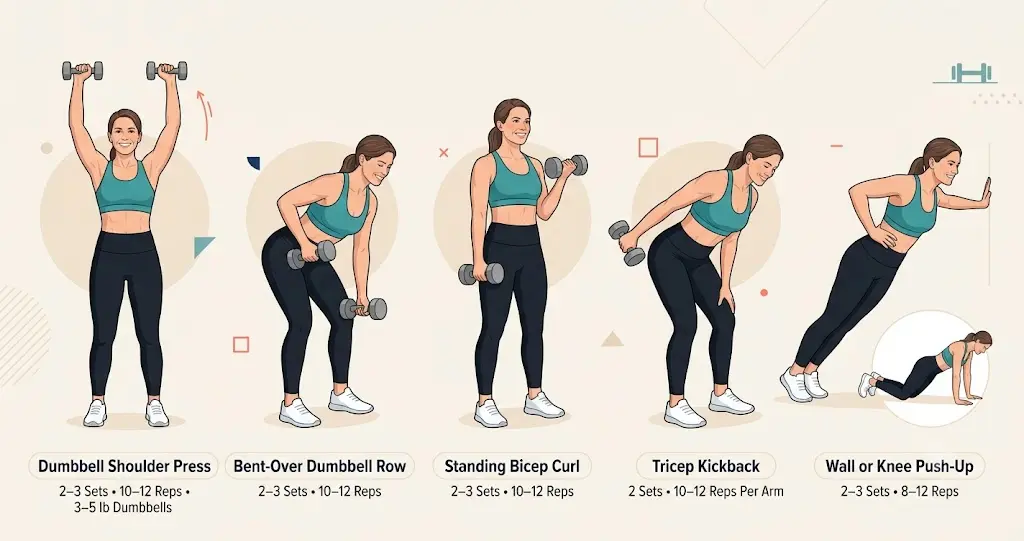
Day 1 — Upper Body
1. Dumbbell Shoulder Press
Works your shoulders and upper back — the muscles that get weak from months of hunching over a laptop or a car seat during school pickup.
- Sets/reps/weight: 2–3 sets of 10–12 reps. Start light — 3 to 5 lb dumbbells are plenty for most total beginners.
- Precaution: If you feel pinching in your shoulder at the top, stop the press just below full extension. That small range is still effective.
2. Bent-Over Dumbbell Row
Targets your upper back and rear shoulders — the “posture” muscles.
- Sets/reps/weight: 2–3 sets of 10–12 reps. A moderate weight — enough that reps 10–12 feel genuinely effortful.
- Precaution: Keep your back flat, not rounded. If your lower back rounds, drop the weight or bring your torso more upright.
3. Standing Bicep Curl
Works the front of your upper arm — a small move, but one that builds confidence fast since it’s easy to feel progress here.
- Sets/reps/weight: 2–3 sets of 10–12 reps.
- Precaution: Avoid swinging your torso to help the weight up — if you need to swing, the dumbbell is too heavy.
4. Tricep Kickback
Targets the back of your upper arm, the area that tends to soften first with age and often bothers women the most.
- Sets/reps/weight: 2 sets of 10–12 reps per arm. Go lighter here than you think — this is a small muscle.
- Precaution: Keep the upper arm still throughout. If your elbow is drifting up and down, the weight is too heavy.
5. Wall or Knee Push-Up
Builds your chest, shoulders, and core all at once — and there’s no shame in starting at the wall.
Knee version: Same movement, performed on hands and knees on the floor instead of standing at a wall — a harder progression once the wall feels easy.
- Sets/reps/weight: 2–3 sets of 8–12 reps, whichever version you choose.
- Precaution: Keep your body in a straight line from head to knees (or head to heels). Don’t let your hips sag — that’s the most common beginner mistake here.
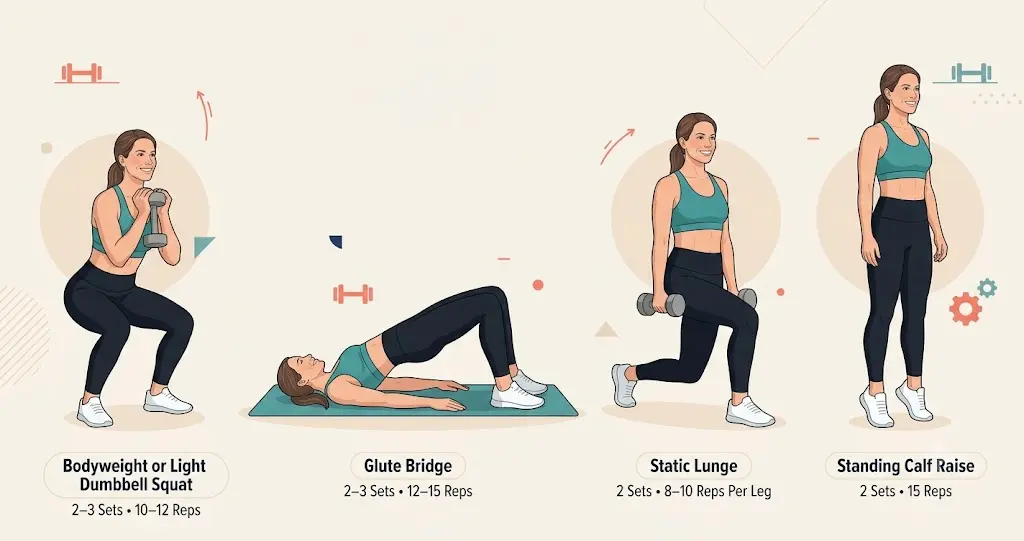
Day 2 — Lower Body
1. Bodyweight or Light Dumbbell Squat
The foundational lower-body move — works your quads, glutes, and hamstrings together.
- Sets/reps/weight: 2–3 sets of 10–12 reps. Start with bodyweight only for the first couple of weeks, then add a single dumbbell held at your chest.
- Precaution: Keep your knees tracking over your toes, not caving inward. If your knees ache, reduce the depth rather than stopping the move altogether.
2. Glute Bridge
Strengthens your glutes and lower back — an underrated move for anyone who sits most of the day.
- Sets/reps/weight: 2–3 sets of 12–15 reps. Bodyweight is plenty to start; add a dumbbell across your hips once this feels easy.
- Precaution: Avoid arching your lower back at the top — the lift should come from your glutes, not your spine.
3. Static Lunge
Builds single-leg strength and balance, which matters more the further we get from our twenties.
- Sets/reps/weight: 2 sets of 8–10 reps per leg. Bodyweight first; hold light dumbbells at your sides once it feels manageable.
- Precaution: Hold onto a chair or countertop for balance if needed — there’s no version of this move that requires you to wobble through it unsupported.
4. Standing Calf Raise
A small, often-skipped move that supports ankle stability and everyday balance.
- Sets/reps/weight: 2 sets of 15 reps. Bodyweight only is enough to start.
- Precaution: Control the lowering phase — dropping quickly reduces how much the move actually does for you.
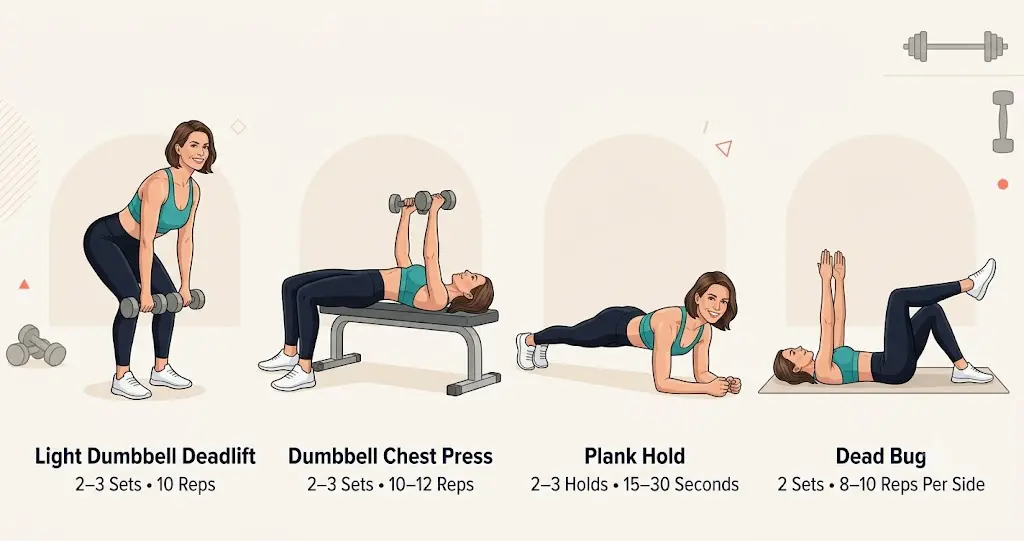
Day 3 — Full Body
1. Light Dumbbell Deadlift
Targets your hamstrings, glutes, and lower back — and teaches you the hip-hinge pattern that protects your back in everyday life, like lifting a laundry basket or a kid off the floor.
- Sets/reps/weight: 2–3 sets of 10 reps. This is the one move on this list where form matters more than weight — start lighter than you think, even 5-lb dumbbells, until the hip-hinge feels natural.
- Precaution: If your lower back rounds at any point, stop, lighten the weight, and rebuild the pattern from there. This move is worth doing slowly and correctly rather than fast and heavy.
2. Dumbbell Chest Press
Works your chest, shoulders, and triceps — the pushing counterpart to the row from Day 1.
- Sets/reps/weight: 2–3 sets of 10–12 reps.
- Precaution: If pressing from the floor, your range of motion will be shorter than on a bench — that’s fine, and still effective.
3. Plank Hold
A core-strength move that also supports the muscles protecting your lower back.
- Sets/reps/weight: 2–3 holds of 15–30 seconds to start, building up over several weeks.
- Precaution: If your lower back aches during the hold, drop to your knees for a modified version rather than pushing through discomfort.
4. Dead Bug
A gentler core move that’s easier on the lower back than a full plank, and a good option on days your back feels tired.
- Sets/reps/weight: 2 sets of 8–10 reps per side.
- Precaution: If your lower back lifts off the floor at any point, shorten the range of motion until it stays flat.
Conclusion
You don’t need a complicated plan. You need water, a daily walk (timed a little smarter), and three beginner strength sessions a week — done consistently, not perfectly.
PCOS means your timeline looks different from someone else’s, and that’s okay. Slow progress is still progress, even on the weeks the scale won’t cooperate.
Start with the glass of water tomorrow morning. Add the post-meal walk. Pick up the dumbbells twice this week. That’s the whole plan.
FAQs
Is walking enough exercise for PCOS over 40?
Walking helps, especially post-meal, but it’s not the whole picture. Pair it with strength training two to three times a week to improve insulin sensitivity and protect muscle and bone — walking alone won’t do either as effectively.
How much water should you drink daily with PCOS?
Around 2.7 liters a day for women is a reasonable general target, trending higher on active days. There’s no PCOS-specific magic number — just don’t let hydration be the habit you forget while managing everything else.
Can beginners over 40 with PCOS do strength training?
Yes, and you should. Beginner-appropriate strength training — light dumbbells, bodyweight moves, two to three sessions a week — is safe and directly helpful for insulin resistance. You don’t need experience to start correctly.
Why is weight loss slower with PCOS?
Insulin resistance, common with PCOS, makes your body hold onto fat more stubbornly than someone without it eating the same deficit. It’s physiology, not a sign you’re doing something wrong.
Is fasting a good idea if you have PCOS?
For many women with PCOS, extended fasting can add more hormonal stress than benefit, particularly around thyroid function. Talk to your doctor before trying it — steady, moderate habits tend to serve PCOS better than aggressive restriction.
About the author: I lost over 30kg through home workouts and food changes, starting with exactly this kind of setup — no gym, no experience, just consistency. I write about women’s hormonal health and fat loss at every life stage at fitwithamna.me.
← Back to all posts