Best Exercises For Pcos Belly Fat For Beginners
Key Takeaways
- Consistency over intensity — 30 minutes of moderate movement 4–5 days a week does more for PCOS belly fat than pushing yourself to exhaustion twice a week.
- PCOS belly fat is hormonal, not a discipline problem — the right exercises target insulin resistance and cortisol directly, which is why generic fitness advice rarely works for us.
- The most effective beginner combo is daily brisk walking + 2–3 weekly strength sessions — this pairing has the strongest evidence for reducing visceral fat and improving insulin sensitivity in women with PCOS.
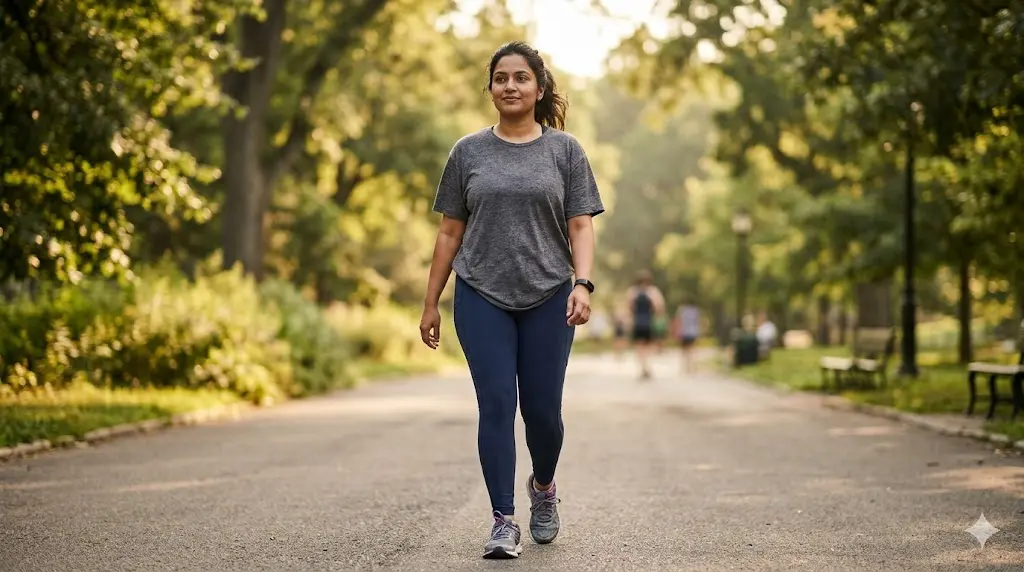
I Know Exactly How That Belly Makes You Feel
I was bleeding continuously for 6 months. Sounds like hell? Yeah it was.
I have been overweight since my teens. I was binge eating and studying. Everything seemed pretty normal when I had continuous bleeding. Injections every other day, drips and medicines felt like a normal routine. I was continuously ashamed of myself being overweight. Even some gynecologists had declared a miscarriage before taking me for an ultrasound.
Sounds crazy? I was just an innocent child with food addiction. Until one day, I decided to dig up the cause and found that I had PCOS.
Normal symptoms of PCOS were hair growth, irregular/missed periods, and headaches. But my symptoms were quite opposite — but yeah, that’s what many females aren’t aware of.
Continuous bleeding is also a sign of PCOS. Medicines, intense workouts, everywhere. But I said no and made my whole plan of what to eat and how to move.
There’s the anxiety that creeps in around food — the restrict-binge cycle that nobody talks about enough, the way PCOS and depression and disordered eating get tangled up together until you can’t tell which came first. There’s the fear before marriage — what if I can’t conceive? What if my body doesn’t work properly? And after marriage, the heartbreak of every month that passes without the news you’re hoping for.
PCOS doesn’t just affect your waistline. It quietly chips away at how worthy you feel in your own skin.
I’ve been there. All of it. And I’ve also lost over 30 kilograms on the other side of it — not by punishing myself harder, but by finally understanding what my body actually needed.
How Does Exercise Actually Help With PCOS Belly Fat?
Exercise helps in three very specific ways:
It improves insulin sensitivity. When your muscles contract during exercise — especially strength training — they pull glucose out of your bloodstream directly, without needing insulin to do it. Over time, this lowers the chronically elevated insulin levels that signal your body to store fat in your abdomen. (Healthline)
It reduces cortisol — when done at the right intensity. This is where most generic fitness advice goes wrong for women with PCOS. High-intensity, high-stress workouts spike cortisol. And high cortisol tells your body to store fat abdominally, disrupt your cycle, and worsen PCOS symptoms. The right exercises lower cortisol. The wrong ones raise it. We’ll get into exactly which is which below.
It builds muscle mass. Muscle tissue is metabolically hungry — it consumes glucose just by existing. Women with PCOS tend to have lower lean muscle mass, which slows metabolism and makes fat loss feel impossible. Even a modest increase in muscle fundamentally changes how your body handles blood sugar and fat storage. (PCOS Personal Trainer)/
The lifestyle piece matters enormously too. Sleep deprivation raises cortisol and worsens insulin resistance. I used to sleep for 3 hours, then I had to pay for the consequences.
Chronic stress keeps androgens elevated. Managing these alongside exercise is what makes the real difference — exercise alone is powerful, but exercise as part of a gentler, more hormonally aware lifestyle is transformative.
What Exercises Get Rid of PCOS Belly Fat?
These are the five types of exercise that have genuine research behind them for PCOS — and exactly how to do them if you’re just starting out.
1. Brisk Walking — Every Single Day
If I had to pick one thing that shifted my PCOS more than anything else in the early days, it was this. Not the gym. Not HIIT. Walking.
Brisk walking lowers fasting insulin, burns visceral fat over time, and — critically — does not spike cortisol the way more intense exercise can.
Studies consistently show that moderate-intensity walking for 30–45 minutes improves insulin sensitivity and reduces inflammatory markers in women with metabolic conditions like PCOS. (Healthline)
For beginners: Start with 20–25 minutes if 45 feels too much. Walk fast enough that talking takes a little effort, but you’re not gasping. Morning walks after breakfast are especially effective — they blunt the blood sugar spike from your meal. Two 20-minute walks throughout the day count just as much as one 40-minute session.
This is your non-negotiable daily habit. Everything else builds on top of it. In the beginning, I used to walk like twenty minutes right after every meal.
2. Bodyweight Strength Training — 2 to 3 Times Per Week
This is where the real metabolic work happens. And you do not need a gym, equipment, or a personal trainer to start.
Resistance training is the single most evidence-backed intervention for PCOS-related insulin resistance. A 2023 review in Sports Medicine confirmed that strength training reduces fasting insulin, lowers the free androgen index, and improves body composition in women with PCOS — with benefits that compound over months. (PCOS Personal Trainer)
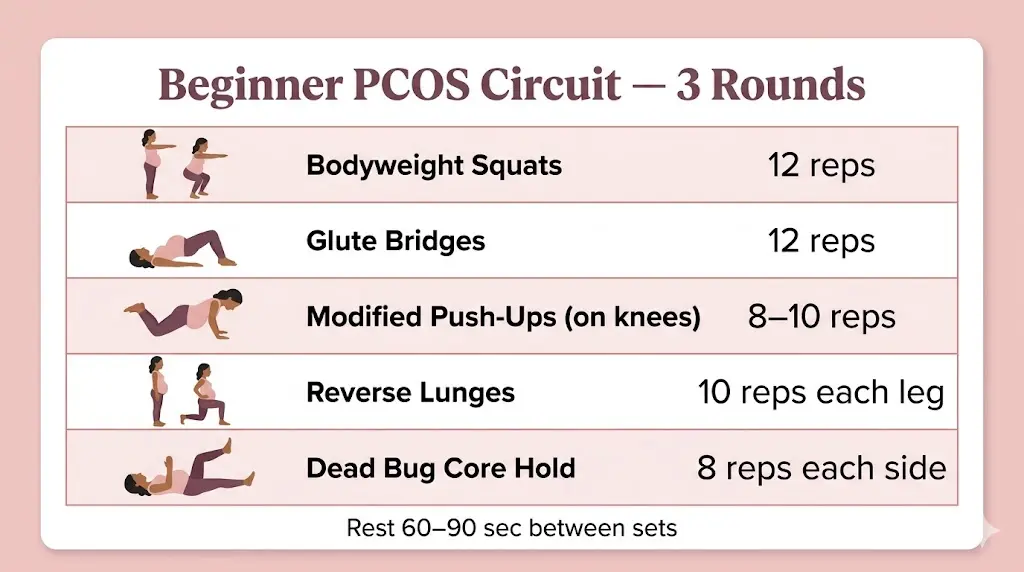
Sessions can be as short as 20–25 minutes. The goal is not to collapse — it’s to feel your muscles working. Mild soreness 24–48 hours later is normal and means the stimulus is doing its job. I still remember the soreness I had at the beginning of my journey.
I started with Roberta. Her workout ranges from a few minutes to a few hours with proper rest time. I used to love her in the beginning of my journey. Many workout sessions don’t give you enough rest time and time to change your position.
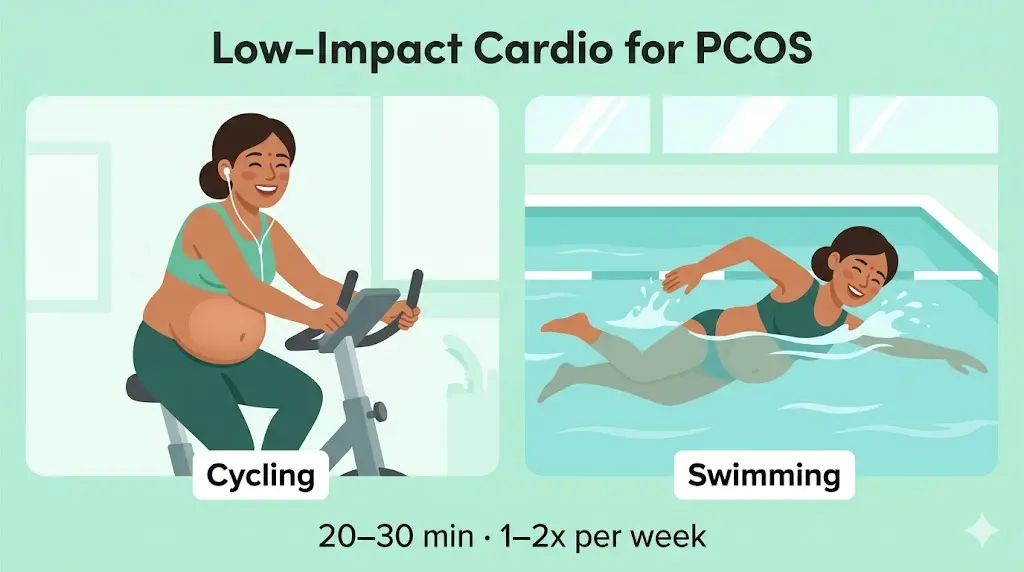
3. Low-Impact Cardio — 1 to 2 Times Per Week
Cycling (stationary or outdoors) and swimming are your best friends on active recovery days. Steady-state cardio at moderate intensity improves cardiovascular health — which is a real and underacknowledged PCOS concern, given that the condition increases long-term risk of metabolic syndrome and heart disease. (AQF Sports)
For beginners: 20–30 minutes at a pace where you feel warm and slightly breathless — not gasping. Use this on days between strength sessions. It keeps you moving without depleting your recovery capacity.
4. Modified HIIT — Once Per Week Maximum
This one needs an honest conversation, because there’s a real debate in the PCOS community about it — and both sides are right.
The case for HIIT: Research shows that high-intensity interval training specifically targets visceral fat — the deep abdominal fat — more effectively than steady-state cardio. Not subcutaneous fat, not all fat equally — visceral fat in particular responds to HIIT in a way that other exercise modalities don’t quite match. A 2022 study confirmed that HIIT produced greater reductions in visceral adiposity in women with abdominal obesity compared to moderate continuous training. (The Gym Starter)
The case for caution: HIIT is not for everyone with PCOS. For some women — particularly those with adrenal PCOS, high baseline stress, or HPA axis dysregulation — HIIT spikes cortisol enough to worsen insulin resistance, disrupt cycles further, and trigger anxiety and exhaustion. This isn’t a personal failure. It’s a hormonal reality. And it’s why “just do HIIT to lose belly fat” is advice that genuinely harms some of us.
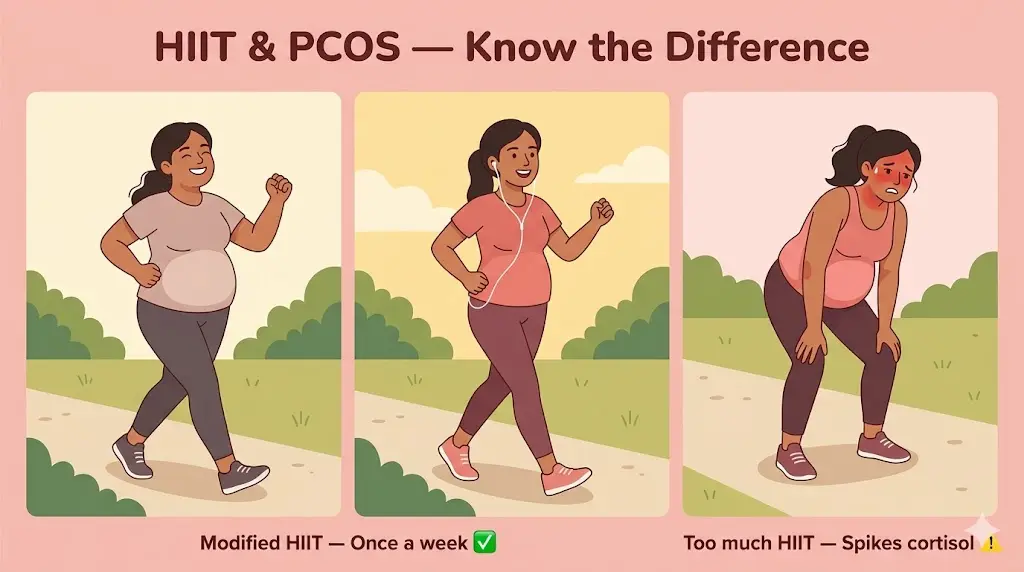
The beginner-safe middle ground: Walk briskly for 2 minutes, then walk as fast as you possibly can for 1 minute. Repeat 6–8 times. Total: about 20 minutes. This gives you the visceral fat stimulus without the extreme cortisol spike of jump-heavy, sprint-based HIIT.
Your warning sign: If you feel wired but exhausted after a session, sleep worse, feel more anxious, or your period timing shifts — skip HIIT for now. Swap it for a second yoga session and revisit in 6–8 weeks when your baseline cortisol has come down.
Download Your Free PCOS Belly Workout Plan PDF
I’ve put together a clean, printable 4-week workout plan with your full schedule, exercise breakdowns, sets and reps, do’s and don’ts, and a weekly progress tracker — everything in one place so you don’t have to hold it all in your head.
You Are So Much Closer Than You Think
I want to leave you with this.
The belly you’re frustrated with right now is not a character flaw. It is not laziness. It is a hormonal condition doing exactly what a hormonal condition does — storing fat in a specific, stubborn pattern because your insulin and cortisol and androgens are running the show in a way they shouldn’t be.
Exercise — the right kind, at the right intensity, done consistently — changes that. Not overnight. Not in two weeks. But in a way that is real, measurable, and cumulative. Energy comes back first. Bloating softens. Sleep improves. The scale eventually follows — but by that point, you’ll already feel different in your body, and that matters more.
Start with the walk. Tomorrow morning, after breakfast. Just 25 minutes. That’s it. Everything else builds from there. And I will be here every step of the way.You’ve got this. I genuinely, wholeheartedly believe that. 🌸
Frequently Asked Questions
What exercises should women with PCOS avoid?
Avoid doing high-intensity training too frequently — daily HIIT, twice-a-day sessions, or combining intense cardio with chronic calorie restriction. Also avoid training in a completely fasted state for long sessions if it leaves you shaky, anxious, or lightheaded. Rest days are not optional — they are when your hormonal repair actually happens.
Can exercise help PCOS go away?
PCOS doesn’t disappear, but consistent exercise can send it into what many women describe as remission. Research shows exercise restores menstrual regularity, reduces androgen levels, improves fertility markers, and lowers the long-term metabolic risks associated with PCOS.
When is the best time to workout with PCOS?
Morning tends to work best for most women with PCOS. Cortisol is naturally highest in the early morning, which means working with that window — rather than fighting your biology — can be metabolically advantageous. That said, the actual best time is the time you will consistently show up for. A 7pm walk you do every day beats a 6am session you hate and skip.
Should I eat before or after a workout with PCOS?
Eat something before, especially for sessions longer than 30 minutes. A light snack with protein and carbohydrates — a banana with nut butter, a boiled egg, Greek yogurt — 30–45 minutes before training helps stabilize blood sugar and prevents a cortisol spike from hunger. After your workout, prioritise protein within 30 minutes: eggs, chicken, lentils, Greek yogurt, or a protein shake.
How soon can exercise show results with PCOS?
Expect to feel the changes before you see them. Energy and mood tend to improve within 2–3 weeks of consistent movement. Bloating and puffiness often reduce within 4 weeks. Visible body composition changes take 8–12 weeks of sustained effort. Hormonal improvements — more regular cycles, reduced androgen symptoms like hair loss and acne — typically take 3–6 months. Track energy, sleep, and mood first.
Disclaimer: This article is for informational purposes only and does not substitute personalised medical advice. Please consult your doctor or a registered healthcare professional before beginning any new exercise programme.
← Back to all posts